
Governing the parish
29 September 2026
Andrew Corbett-Nolan looks at the legal architecture, roles and practice of good governance in Church of England parishes.
Points raised:
- Parish church councils are charity trustees governing public assets.
- Churchwardens, as the bishop's officers, hold parishes through vacancies.
- Clear roles, written schemes and records prevent governance failure.
- Sedlescombe shows parish stewardship means caring for centuries of history.
Parochial governance in the Church of England is one of the oldest continuously operating systems of local public-purpose administration in England. It is not a simple congregation-plus-clergy model. It is a hybrid of ecclesiastical office, statutory corporation, charity trusteeship and civic custom.
The incumbent and the Parochial Church Council (PCC) are jointly charged with promoting “in the parish the whole mission of the Church, pastoral, evangelistic, social and ecumenical.” That phrase, from the Parochial Church Councils (Powers) Measure 1956, is both the charitable purpose and the constitutional north star.
Good governance is the means by which mission, stewardship of buildings and money, safeguarding and the care of souls are held together. Anyone who has sat through an Annual Parochial Church Meeting that resembles a slightly less amusing episode of The Vicar of Dibley will recognise the human texture: deeply felt local attachment, occasional procedural muddle and the need for chairs who can keep both the minutes and the peace.
This paper sets out the legal skeleton of parish governance, the principal offices and bodies, the particular stresses of vacancy and fabric projects and the application of contemporary good-governance principles (ethical culture, performance, effective control and legitimacy) to the parish as a public-purpose organisation.
Why parish governance matters
A Church of England parish is a territorial unit with a duty to a whole population, not only to those who attend public worship. The parish church is frequently the most significant historic building in a local area, and the PCC is frequently the last remaining civic body with a statutory duty of care for a place that is open to all. The governance question is therefore not merely internal church administration. It is the stewardship of a public asset, a charitable purpose and a pastoral obligation that predates modern local government.
Failure modes are well known across the public and third sectors and can often appear in parishes in trumps:
- purpose drift: the council just focuses on maintaining a familiar Sunday pattern rather than to promote the whole mission of the Church
- role confusion: churchwardens become a shadow executive, or the incumbent treats the PCC as a rubber stamp
- weak control: finances known only to the treasurer, safeguarding held as personal knowledge rather than a documented system, fabric decisions taken without proper approvals
- weak legitimacy: papers circulated on the morning of the APCM, elections uncontested because nobody understands what the offices require.
The Church Representation Rules as revised from 2020 onwards were expressly intended to simplify local governance and allow parishes to adapt arrangements (including joint PCCs and hybrid meetings) so that structure serves ministry rather than the other way around. Adaptation is not a sort of loophole or fudge. It is an invitation to design a governing arrangement that a multi-parish benefice can actually operate.
The legal skeleton
Four separate instruments are the critical authorities parish governance depends on:
1. Parochial Church Councils (Powers) Measure 1956
The 1956 Measure, as amended, constitutes every PCC as a body corporate with perpetual succession. It may acquire, hold and dispose of property, enter contracts, employ staff and sue and be sued in its own name. Section 2 sets the principal function: co-operation with the minister in promoting in the parish the whole mission of the Church. There is a reciprocal duty of consultation between minister and council on matters of general concern and importance to the parish. Liabilities in contract or tort attach to the corporation, not automatically to individual members, unless a member has accepted personal responsibility or has breached fiduciary duty.
2. Church Representation Rules
The Rules, contained in Schedule 3 to the Synodical Government Measure 1969 and issued in a 2025 edition reflecting subsequent amendments, govern membership of the PCC, the church electoral roll, the Annual Parochial Church Meeting, elections, meetings (including electronic, hybrid and virtual presence), and options for local schemes such as joint councils. They are the parish’s standing orders. They also now reflect strengthened safeguarding expectations on church bodies and officeholders.
3. Churchwardens Measure 2001
The Measure provides that there shall be two churchwardens of every parish, elected by a meeting of the parishioners (a wider franchise than the electoral roll alone), from persons who are baptised, on the roll, actual communicants, twenty-one or over, and not disqualified (including disqualification as a charity trustee). They are admitted by the archdeacon on behalf of the bishop, normally by 31 July. A person who has served six successive periods of office is disqualified until the meeting in the next year but one, unless the meeting of parishioners resolves that the limit shall not apply. Churchwardens are officers of the bishop, not of the incumbent or the PCC.
4. Charity law
Every PCC is a charity. Those with gross annual income over £100,000 must register with the Charity Commission. Those below that figure are excepted from registration but not from charity law. A PCC with income over £5,000 may register voluntarily now; many do so because a charity number often helps with grant applications. The exception for these churches ends on 31 March 2031. From that date every PCC with income over £5,000 will have to be registered. Parish Resources expects phased onboarding for Church of England PCCs to start in 2026, so councils would be wise not to leave it to the last minute.
Every member of the PCC (clergy ex officio, churchwardens, elected and co-opted lay members) is also a charity trustee and so the Charity Commission’s duties apply in full:
- ensure the charity carries out its purposes for the public benefit
- comply with the governing document and the law
- act in the charity’s best interests
- manage resources responsibly
- act with reasonable care and skill
- ensure the charity is accountable.
Conflicts of interest and of loyalty are often acute in small communities where the same people sit on the PCC, the village hall committee and the school governing body.
Canon law, the faculty jurisdiction, the Mission and Pastoral Measure framework, Common Tenure and national safeguarding policy sit around this core. None of them displaces the PCC as trustee body or the churchwardens as the bishop’s officers.
The governing cast
The incumbent – the rector, vicar or, in many modern arrangements, priest-in-charge holds the care of souls. The minister chairs the PCC. Where there is no minister, or the minister is absent or unable to act, the elected lay vice-chair acts as chair and holds the chair’s powers. The incumbent is not an employee of the PCC. Clergy on Common Tenure hold an ecclesiastical office with statutory terms of service, a role description and a statement of particulars. They are not employed under a contract of employment in the ordinary sense, though capability and grievance procedures now exist that would have been unrecognisable a generation ago.
Chairing well is a governance skill, not a liturgical one. The chair’s job is to ensure that the council addresses purpose, risk and resource; that dissent is possible without rupture; and that decisions are recorded as decisions. A PCC that only receives last Sunday’s notices and next year’s fete date is administering, not governing.
Churchwardens – Canon E1 and the 2001 Measure together describe an office that is older than the PCC and, in vacancy, more operationally consequential. I have been a churchwarden myself and it is a testing and time-consuming role. Once admitted, churchwardens:
- are officers of the bishop
- must be foremost in representing the laity and co-operating with the incumbent
- must use their best endeavours by example and precept to encourage the parishioners in the practice of true religion and to promote unity and peace among them
- must maintain order and decency in the church and churchyard, especially during divine service
- hold title to the plate, ornaments and other movable goods of the church, keep an inventory, and hand the goods to their successors.
They are ex officio members of the PCC. During a vacancy in the benefice, they are sequestrators together with the area or rural dean and anyone else the bishop appoints. Sequestration is no small accountability. It carries responsibility for continuity of worship, the building, liaison over the parsonage with diocesan property officers and the fulfilment of the incumbent’s safeguarding roles in consultation with the parish safeguarding officer and the area dean.
The Parochial Church Council – membership typically comprises licensed clergy beneficed or licensed to the parish, licensed lay workers, churchwardens (and churchwardens-elect until admission), elected representatives of the laity and a limited number of co-opted members. In a team ministry, team members sit as provided by the Rules. The PCC must meet at least four times a year. It is responsible for finance, the care and maintenance of church buildings and contents (subject to faculty jurisdiction), insurance, the employment of lay staff and co-operation in mission. It elects representatives to the deanery synod and thereby into diocesan and General Synod.
The PCC is the decision-making body. Sub-committees, standing committees and informal “leadership teams” may prepare business. They cannot lawfully replace the council on matters reserved to it. Minutes should record decisions, conflicts declared and the information on which decisions were taken. This is the critical audit trail that protects both the charity and the people who serve it.
The electoral roll, the meeting of parishioners and the APCM – the church electoral roll is the list of lay persons qualified to vote in PCC and deanery elections and to stand for those offices. The meeting of parishioners elects the churchwardens; its franchise is wider than the roll and includes resident parishioners. The Annual Parochial Church Meeting, held between 1 January and 31 May, receives the reports required by the Rules (including independently examined or audited accounts prepared under the Church’s accounting rules and, where applicable, the Charities SORP), elects PCC members and deanery synod representatives, and appoints sidespersons and the independent examiner or auditor.
Patron, bishop and the wider Church –patronage and presentation sit above the parish but constrain it. In a vacancy the PCC elects two lay representatives whose consent, together with the bishop’s, is required for the patron’s presentee. Diocesan boards of finance, diocesan advisory committees, archdeacons and the faculty system are the intermediate layer through which buildings, pastoral reorganisation and finance are supervised. Deanery and diocesan synods are the representative ladder. None of this relieves the PCC of trustee responsibility for the parish as a charity.
Trustee duties in a parish setting
The Charity Commission’s duties map onto parish life with uncomfortable precision.
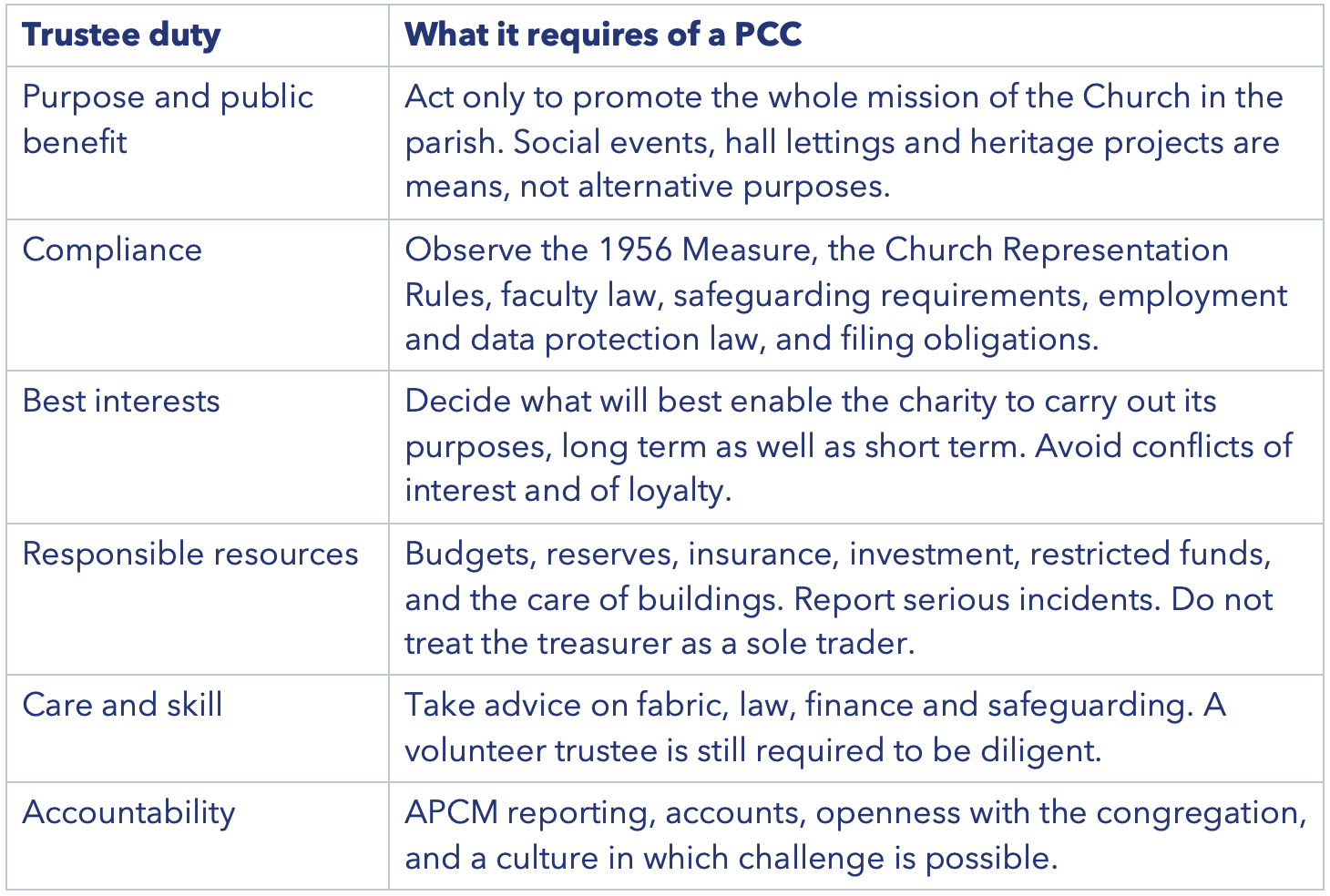
Restricted funds are a frequent source of accidental breach. Money given for the organ, the churchyard or a named mission project cannot be raided for the general deficit because the heating oil has run out. Reserves policies should be written, reviewed and explained at the APCM. Personal liability is rare if the corporation acts properly; it is a possibility if a PCC member orders works without authority or allows the charity to trade insolvently.
Vacancy, interregnum and succession
An interregnum tests governance more severely than ordinary years. Sequestrators must keep services going, the building safe, records in order and the parish open, while a new appointment is negotiated through patron, bishop and parish representatives. Safeguarding files must be held securely by the parish safeguarding officer and handed to the incoming incumbent. The parsonage is a diocesan property responsibility in which churchwardens have a practical role: keys, security, access for contractors.
Good practice in vacancy is the same as good practice in any public-purpose organisation in transition:
- a written scheme of what sequestrators and the standing committee may decide, and what must wait
- a single set of minutes that record decisions rather than conversations
- continuity of statutory roles — safeguarding, fabric inspection, insurance, filing
- communication with the congregation
- a parish profile that describes the parish as it is, not only as the last incumbent wished it to be.
Reordering or major fabric works during a vacancy concentrate every governance tension (heritage, mission, money, taste and succession) into a single faculty petition and a single set of accounts. A project begun under one incumbent and completed under another requires the PCC to own the purpose of the works as a trustee decision, not as a personality project.
Buildings, money and safeguarding
Faculty jurisdiction exists because parish churches are not private property. Quinquennial inspections, the diocesan advisory committee, and, where relevant, Historic England, the Victorian Society and local planning, form a control system that can feel slow to a PCC in a hurry and indispensable to a PCC that has just discovered dry rot in a listed chancel. The churchwardens’ inventory of movables is critical to keep up to date and accurate. Insurance will need to match the inventory and the quinquennial report.
Financial governance requires a treasurer, a PCC that keeps itself informed on finances, an independent examiner or auditor appointed at the APCM, and accounts that distinguish unrestricted, designated, restricted and endowment funds. Parish share (or quota) is a diocesan apportionment, not a free-will offering that can be withheld as a negotiating tactic without consequences for the wider Church and, often, for the parish’s own standing.
Safeguarding is now a defining test of ecclesiastical governance. Churchwardens, the incumbent and the PCC share responsibility with the parish safeguarding officer. In vacancy, churchwardens must ensure that the incumbent’s safeguarding roles are fulfilled. National reforms, including moves toward a more independent national safeguarding architecture, do not remove local trustee responsibility. They raise the standard against which that responsibility will be judged. Safer recruitment, training, record-keeping, and the reporting of serious incidents to the Charity Commission where required are board-level issues, not a volunteer who “does DBS”.
A parish in place: Sedlescombe
Good parish governance is never only a matter of Measures and minutes. It is the stewardship of a particular place. Sedlescombe, the parish in which I served as a churchwarden, illustrates how deep that place-story can run.
Sedlescombe is a Sussex village from Central Casting. The valley of the River Brede was already an industrial landscape when the Romans arrived in the first century. Iron Age bloomeries using Wealden ironstone and woodland charcoal were scaled at Oaklands and Footlands into production of a size that served the military economy of the province. A Roman road on the Rochester–Maidstone–Hastings line passed immediately west of the later village; a branch served the Footlands workings. Coins recovered from ancient cinder-fields, slag reused as hardcore in later centuries, and the line of the road are the archaeological residue of that phase. The Roman coastline of the Rother and Brede estuaries was not the coastline of today. Water transport up the Brede was part of what made the iron workable at volume.
After the Conquest the manor recorded in Domesday - held in the Confessor’s day of Countess Godgifu (Goda) by the Saxon Leofsi, then of Robert, Count of Eu, by Walter son of Lambert - was drawn into the orbit of Battle Abbey.
It was the Abbey that gave the village its purpose. From the 1290s grants of plots produced a street settlement rather than a disbursed agricultural settlement. The monks laid out dwelling plots on the east side of what became The Green. Those plots lack the long agricultural tofts of a classic Midland village; they combine to give Sedlescombe one of the highest proportions of surviving medieval houses in the district. The Green itself, unusual among Wealden settlements, may have served as the place of the court leet. By the mid-sixteenth century some twenty-two houses stood along The Street, split between Battle Manor on the east and Bricklehurst on the west. Knights Hospitallers held a commandery founded in the time of King John. Ironworks returned in the Tudor Wealden revival at Brede Furnace; the medieval corn mill later milled gunpowder.
As the coastline receded in effect from the upper Brede and the river ceased to be a working navigation, Sedlescombe’s reason for being changed. What had been a riverhead for an abbey estate became a roadside village on the Hastings–Hawkhurst road, its economy folding back into farm, forge, tannery memory and, eventually, the conservation of its own plan. The long, narrow triangular green — pump house of 1900 at its heart, timber-framed houses from the fifteenth century along its flanks, the Grade I Manor Cottages just north, the Grade II* parish church of St John the Baptist a little apart on Church Hill — is the form that history left when the waterway closed. The church’s fifteenth-century Perpendicular nave, north aisle and west tower, with Victorian chancel and south aisle by Norman and Billing, stand on a site of earlier worship. Parish registers begin in 1559. The civil parish remains an ancient parish in the old county sense: Staple hundred, rape of Hastings, latterly the diocese of Chichester and now the benefice of Sedlescombe with Whatlington.
That is the place a PCC actually governs: not an abstract “community resource”, but a settlement whose green, street, bridge and churchyard are the visible end of Roman industry, monastic estate management, a lost navigation and the slow making of an iconic Sussex village. Stewardship of the building and the churchyard is therefore stewardship of a public landscape that the village did not invent last Tuesday. The church reordering, over which the author painfully presided as churchwarden, needed to respect that longer story. So does every faculty, every quinquennial and every argument about how a listed church should be used.
A personal note
For five years I served as churchwarden of the parish church of St John the Baptist, Sedlescombe — my home parish, where I was baptised, where my parents were married, and in whose churchyard they lie. I held office, as I recall, from 2010 to 2015. In that time, I had the extremely testing duty of presiding, with my fellow warden and the area dean, over an interregnum, and of seeing through a substantial reordering of the church.
Those years confirmed what the law only sketches. Churchwardens are officers of the bishop charged with continuity when the cure is vacant. The PCC remains the trustee body. Fabric projects concentrate every governance tension into a faculty, a fundraising appeal and a set of accounts that must still be true when the new incumbent arrives. The work is unpaid, often unseen, usually unthanked and occasionally bruising. It is also one of the last remaining forms of serious local trusteeship that a lay person can exercise for the place they love.
That experience is why parish governance is not a niche ecclesiastical curiosity for GGi. It is local public-purpose governance under statute, charity law and a theological mandate. Done well, it stewards a building, a community and a mission. Done poorly, it produces exactly the mixture of affection and farce that The Vicar of Dibley captured and that no serious trustee body can afford.
Practical recommendations
- Treat the PCC as a board. Circulate papers in advance. Record decisions. Declare conflicts. Review effectiveness once a year.
- Write down who does what in vacancy before the vacancy occurs. Sequestrators should not invent a scheme of delegation in the moment.
- Use the Church Representation Rules’ flexibility. Joint councils and adapted arrangements are lawful tools for multi-parish benefices, not admissions of defeat.
- Give every new PCC member a clear briefing on trustee duties, restricted funds, safeguarding and faculty. Induction is cheaper than a Charity Commission inquiry.
- Link the budget to purpose. If the only growing line is insurance and the only shrinking line is mission, the council has already made a strategic choice without admitting it.
- Keep the inventory, the quinquennial and the insurance schedule in the same folder. Movables that exist only in memory are neither insured nor handed on.
- Make safeguarding a standing item with a named officer present, not an annual nod. In vacancy, name who holds the incumbent’s duties.
- Conduct elections as if the offices are real. Six-year churchwarden limits exist for a reason; so does the power of the meeting to set them aside for a defined purpose, such as continuity through an interregnum.
- Use the APCM well. Accounts, attendance, fabric and the state of the vacancy are not private griefs of the officers and should be shared with the congregation.
References and further reading
- Church of England, Church Representation Rules (Church House Publishing, 2025 edition).
- Church of England, PCC Accountability (Church House Publishing; current edition incorporating Charities SORP guidance).
- Parochial Church Councils (Powers) Measure 1956 (as amended).
- Churchwardens Measure 2001 (as amended).
- Synodical Government Measure 1969, Schedule 3.
- Canons of the Church of England, especially Canon E1.
- Charity Commission for England and Wales, The essential trustee: what you need to know, what you need to do (CC3).
- Church of England, Roles and Responsibilities: Practice Guidance (safeguarding), and subsequent national safeguarding codes and reforms.
- Church of England, Mission and Pastoral Measure framework and Code of Practice.
- Institute of Directors in South Africa, King IV Report on Corporate Governance for South Africa (2016).
- Corbett-Nolan, A. and Allanson, P., High-performing boards: what they are and why they are important (Good Governance Institute, 2024).
- Parish Resources / Church of England national pages on PCCs, churchwardens and the APCM.
- Victoria History of the County of Sussex, manor of Sedlescombe; Domesday and later tenures including Battle Abbey at Iltunesbeth / Tyltonesbathe.
- Rother District Council, Sedlescombe Conservation Area Appraisal (origins of the settlement, the Green, Battle Abbey plots).
- Battle and District Historical Society / Pauline Raymond, Sedlescombe village history papers, especially iron and charcoal.
- Archaeology South-East and related desk-based assessments for sites in Sedlescombe (Roman road and ironworking; Iltonsbath; navigability of the Brede).
- Mark Gardiner and related work on medieval farming and flooding in the Brede valley; Martin, Martin and Gardiner on the planned later-medieval village.
- Historic England list entries: Church of St John the Baptist, Sedlescombe (Grade II*); Manor Cottages.
- Seton, Anya, Green Darkness (Houghton Mifflin, 1972) — historical novel focusing on Battle Abbey and the post-Dissolution Browne estates.
- The Good Governance Institute intends this paper as the first in a series on ecclesiastical governance. Correspondence: andrew.corbett-nolan@good-governance.org.uk