
Healthcare organisations succeed or fail in the middle
06 November 2026
Professor Andrew Corbett-Nolan's new paper on clinical directors, the triumvirate and what it takes to make an NHS provider genuinely clinically led
In brief. NHS providers succeed or fail in their clinical divisions and care groups, not at the board, and a board that wants a clinically led organisation in fact rather than in name should do three things. It should make the clinical director of each care group the accountable executive of that service, leading a team that owns quality, performance, workforce and money together. It should run the clinical director’s managerial line to the chief operating officer and bring the clinical directors into the chief executive’s management team as full members. And it should treat the creation of the conditions in which capable clinicians will take and keep these posts as the executive’s first job, because where the model fails it almost always fails in practice rather than in design. This paper summarises the argument and the evidence of the full GGi paper of the same title and ends with what boards should do now.
The situation, the complication and the question
Every NHS trust and health board describes itself as clinically led, and the policy environment now takes that description for granted. Advanced Foundation Trust status, integrated health organisation contracts and system working all assume that below the board there is a tier of leadership able to own quality, performance and money together. That tier is the clinical division, care group or service group (I use ‘care group’ for all of them), and it is where strategy is turned, day by day, into patient care, cost and culture.
The complication is that in many providers the tier does not work as the board believes it does. The three people who nominally lead each care group report in different directions, so medicine speaks to the medical director, nursing to the chief nurse and operations to the chief operating officer, and nobody is the executive of the service. The doctor in the chair is allowed to confine himself or herself to quality, while the general manager is left to deliver figures over which he or she has no real control. The result is an organisation that is clinically advised rather than clinically led, and the research suggests that such organisations fail without noticing until it is too late. Nor is the problem solved simply by drawing the right structure. Helen Dickinson, Chris Ham and their colleagues found, in their study for the National Institute for Health and Care Research, that most trusts had a doctor, a nurse and a general manager in each principal unit, but that many of the people they interviewed did not recognise the term ‘triumvirate’, and that the relationship which actually ran the service was usually the pairing of the medical lead and the general manager. GGi’s own governance reviews find the same gap between the organogram and the way services are really run.
The question for boards is therefore a practical one. What design of leadership in the middle of the organisation actually works, and what does the board have to do to make it work? The answer rests on three propositions.
1. Providers succeed or fail in the middle – and most boards cannot see it happening
The middle matters for three reasons. It is the only point at which professional and corporate authority can be reconciled, because consultants, senior nurses, allied health professionals and general managers each have a legitimate claim on the service and, unless they are bound into a single executive arrangement, they fall back into parallel hierarchies whose gaps patients fall through. It is where performance is actually generated, since waiting lists, agency spending, theatre utilisation and patterns of serious incident start as care-group problems and reach the board only later. And it is the only level at which improvement can be owned rather than administered, because pathway redesign and disinvestment cannot be done to a care group from outside; they have to be led by people whose clinical credibility will carry the consultant body with them.
Three pieces of evidence bear this out. David Buchanan’s study for the National Institute for Health and Care Research found that, once hybrid clinical and managerial roles were counted, more than 30% of the hospital workforce carried managerial responsibility, hybrids outnumbered full-time managers by four to one, most had little or no management training and over half considered their jobs unmanageable. Mary Dixon-Woods and colleagues, in the largest study of culture and behaviour in the English NHS, found organisations with unclear goals, compliance-orientated management and real difficulty in obtaining valid insight into the quality of their own care, preferring comfort-seeking to problem-sensing. And Robert Francis described the end of that road at Mid Staffordshire as a disengagement from managerial and leadership responsibilities.
The implication for governance is that if the middle is badly designed, no initiative at board or programme level will rescue the organisation, whereas if it is well designed the board is freed to do what only a board can do: settle purpose and risk appetite, seek assurance and hold a coherent executive to account.
2. One design makes the middle work: a clinically led care group that owns the whole scorecard
The design has four elements, and each is already in use somewhere in the NHS.
A clinical director who is the executive of the service. The clinical director, a senior doctor in most acute services and a senior nurse, midwife or allied health professional where theirs is the profession that carries the service, leads the care group as first among equals with the nursing or allied health lead and the operational manager. The three keep one scorecard covering quality, performance, workforce, finance and improvement, meet as a standing executive, and take their hard decisions together into the consultant meeting. Accountability is shared, but it is the clinical director who is held to account for the whole of it, and the design must not allow the medical member to stand aside from money, waiting times or operational performance. Maidstone and Tunbridge Wells, Barking, Havering and Redbridge, and Manchester University NHS Foundation Trust all write this into their operating models and job descriptions.
Two lines of accountability, kept distinct. For the running of the care group, the nurse and the manager report to the clinical director, who reports to the chief operating officer, who reports to the chief executive. The professional lines to the medical director and the chief nurse remain essential for professional standards, revalidation and safer staffing, but they are how the board is assured that the professions are safe, not the means by which the service is managed. Running the operational line through the medical director turns that post into a second chief operating officer and gives the clinical director a comfortable home in which quality can be discussed without reference to money or flow. Span of control is not the objection it appears to be: a chief operating officer who holds five or six clinical directors, each carrying a whole service, has fewer accountable relationships than one to whom every director of operations and head of nursing reports separately.
One management team. The clinical directors sit with the executive directors as full members of a single management team chaired by the chief executive, rather than attending when invited to explain their performance. That changes the conversation at the centre of the organisation from corporate business to the running of services, makes the allocation of resources a negotiation among peers who each carry a budget, and removes the possibility of a doctor describing a decision afterwards as ‘management’s’. The forum is the executive, not the board; non-executive directors do not sit on it, and the unitary board’s independent challenge is untouched.
A strong collective voice for the consultant body. The medical staff committee, in whatever form a trust has it, is the independent voice of the consultant body and the organisation-wide counterpart of the care group’s consultant meeting. Properly resourced and heard by the board through a standing report, it is where a clinical director's leadership is tested by peers and where senior doctors raise emerging risk early. Treated as a formality, it becomes the focus of organised dissent.
The evidence that clinical leadership of this kind improves performance is consistent, even though no trial has tested this precise organogram. Veronesi, Kirkpatrick and Vallascas found that a higher share of doctors on English trust boards was associated with better quality ratings and lower mortality, with a move from the lower to the upper quartile raising the predicted probability of a top rating from 23% to 30%, and their tests against reverse causation held. Kirkpatrick, Altanlar and Veronesi later showed that a critical mass of medical leaders in trusts’ senior management teams was associated with better patient experience and lower infection rates, which is the local equivalent of bringing the clinical directors into the management team. And Spurgeon’s work with the Medical Engagement Scale, together with Dickinson and Ham’s study for the NIHR, found that medical engagement rather than structure explained the difference between better and worse performing trusts, which is why the third proposition matters as much as the second.
3. The executive's job is to create the conditions in which capable clinicians will take these posts and succeed in them
The organisation needs good clinicians to become Clinical Directors a great deal more than those clinicians need the role, and the Health Foundation’s 2024 research found that in some services the posts are poisoned chalices, taken reluctantly, filled because it is someone’s turn and given up with relief. The same study by Dickinson and Ham found that medical leaders occupy a precarious middle ground between the executive and the consultant body, with gaps in engagement with colleagues all too common. Lord Darzi’s 2024 investigation called for exactly what this requires: investment in managerial talent and in creating the conditions for success.
Five conditions matter most, and all five are within the executive’s gift. Time, because two programmed activities a week against a full clinical workload produces a correspondence job with a title; four are needed, and six are better, with a named deputy. Support, in the form of finance, people and governance partners, analytical capacity and the development set out in the Leadership and Management Framework launched in July 2026. Authority that matches the title, so that the team can appoint, move resources, discontinue a pathway and take a concern about a consultant into process. A culture in which the executive is seen to back difficult decisions rather than using the clinical director to relay them. And a career with enough tenure to lead and a visible route onwards, because doctors who know they will return to the ranks of their colleagues are deterred from decisions that would alienate them.
The model fails in nine recognisable ways, most of them failures of design: a triumvirate in name only; three dotted lines and no executive; operational reporting to the medical director; management team membership by invitation; accountability without the budget; the incidental hybrid who takes the post to defend a specialty; inadequate time and no deputy; an added layer that leaves nobody holding the chief operating officer’s account; and system meetings that hollow out the care group.
What boards should do now
A board that wants to know whether it is clinically led should be able to answer the following in public. If it cannot answer the questions on delegation, reporting lines, management team membership and time in the affirmative, it does not yet have the model, however much it may have the language.
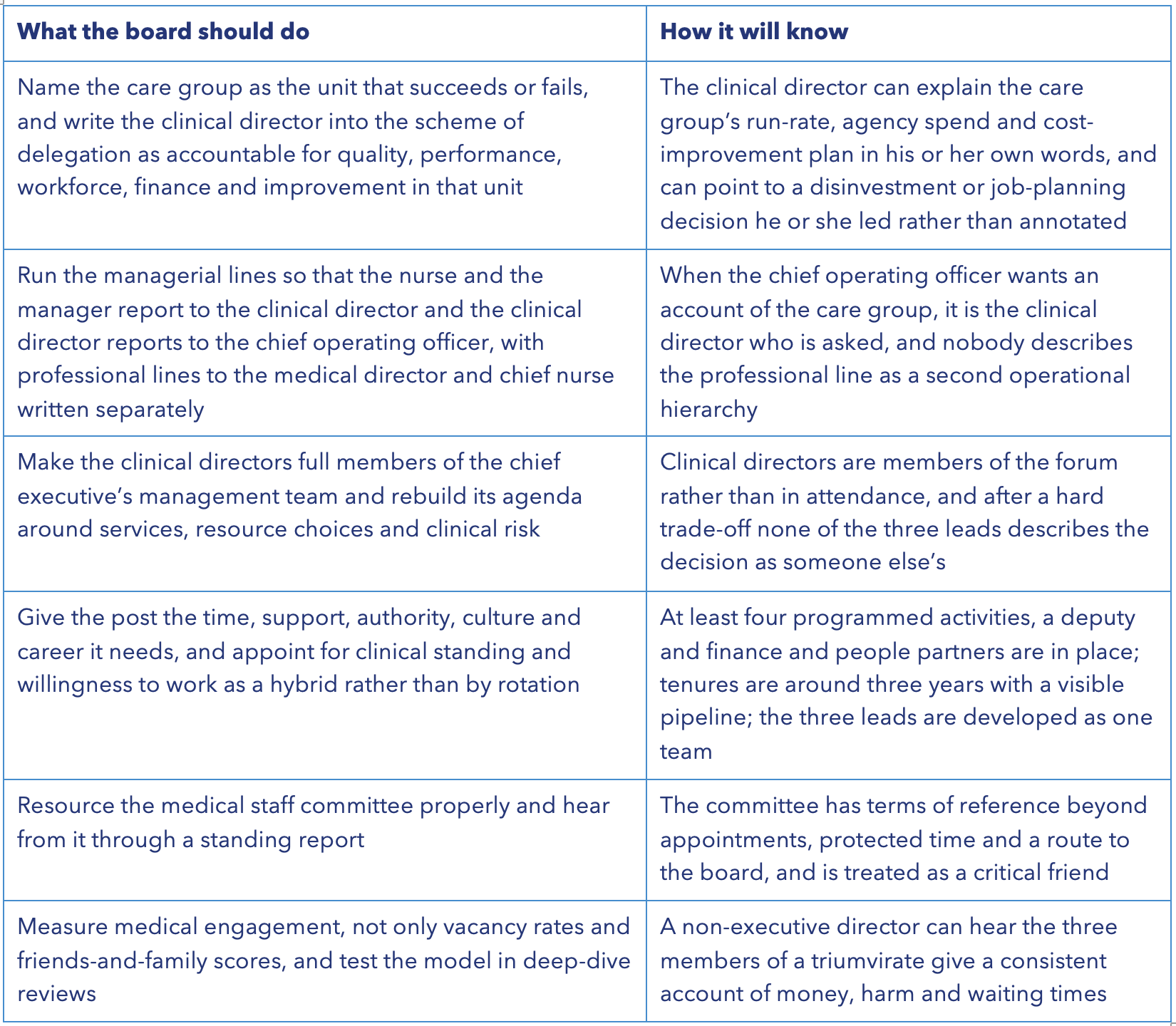
Structure is necessary but it is not sufficient. The research and GGi’s experience of reviewing trusts and health boards both show that unless the three leads work as one team, unless the clinician in the chair is answerable for the whole scorecard, and unless the executive and the care groups behave as a single leadership system rather than as principal and agent, the model will go on being described far more often than it is practised. The board’s part is to design for it, to pay for it, and then to ask, in public, whether it has actually happened.
The full paper, with the evidence, the examples from England, Wales and Scotland, the checklist for boards and the answers to the questions boards most often ask, is available by clicking below.