
The myth of the quick fix: what recovery and the 'left shift' actually look like in large NHS organisations
02 September 2026
Andrew Corbett-Nolan examines why NHS recovery takes time, why stable leadership matters, and why the shift from hospital to community care remains difficult to deliver at scale.
Points raised in this article
- NHS recovery is slow: lasting improvement often takes years.
- Leadership continuity matters: stable executives help sustain change.
- Quality and financial recovery are separate challenges.
- The NHS ‘left shift’ remains largely unproven at scale.
Real change requires funding to follow care into communities.
Large NHS organisations that have failed badly do recover. They almost never recover quickly, they almost never recover completely and they often slip. That is the first inconvenient finding from a look across the best-documented English (and some Welsh) cases of the last decade. The second finding is sharper still. National policy now talks as if care and money can be moved, at scale, out of hospital and into community and primary care within a planning cycle. The published evidence does not support that claim.
What follows is not a counsel of despair. It is our attempt to separate what boards can honestly learn from what they are often invited to believe.
Recovery is real. It is also unfinished
For these purposes, recovery does not mean an ‘Outstanding’ rating or a completely clean bill of health. It means the organisation is no longer a public safety scandal; regulators have stepped back or changed the nature of their grip; staff and partners can describe a different way of working and the board has agency and can show that improvement is not wholly dependent on the current intervention regime.
University Hospitals of Morecambe Bay is the right calibration for this. The Kirkup investigation (2015) documented serious failures in maternity care between 2004 and 2013 and failures of regulation around the trust. Special measures followed in 2014. CQC’s Driving Improvement work recorded the first climb: out of special measures in December 2015, rated Good in 2017. That took roughly three years from special measures and more than a decade from the original cluster of deaths. It did not last cleanly. In 2021, after a downturn and whistleblowing activity, the trust was placed in NHS England’s Recovery Support Programme and had conditions imposed on registration. Those conditions on medical and maternity services were lifted in June 2023.
Focused inspections in July 2025, published in January 2026, rated maternity Good at Furness General, Royal Lancaster Infirmary and Westmorland General — the first time all three units have been Good since 2017. Urgent and emergency care at Furness moved to Good; Lancaster ED remains Requires Improvement. The overall trust rating remains Requires Improvement. The organisation reports that it left recovery support during 2024/25 and is trying to move from “change because we were told to” to “change under our own hand”. That is a useful comparator precisely because it is imperfect. Also to note the remarkable and able chief executive who oversaw this process was an executive director at the trust for 12 years, seven years and seven months of which were as chief executive.
A note on the 2021 relapse is worth making, because it is often flattened into a simple story of “they went backwards”. Niche Health and Social Care Consulting’s independent investigation into urology services was extremely thorough. Amongst many other things it rightly discussed whistleblowing potentially being “weaponised” (section 1.2) and how difficult and complex it is to separate the noise from the actual evidence (which Niche did). Fairly or unfairly, elements of the noise that followed the urology issues almost certainly lowered NHS England’s risk appetite for letting the trust leave special measures. When an organisation is said to ‘relapse’ it is sometimes about real deterioration. It is sometimes also about how a system hears a small number of loud voices.
The other well-documented journeys point in the same direction.
East Lancashire Hospitals, after Keogh special measures in 2013, became one of CQC’s clearer two-notch recoveries and remains Good overall. However it has not been a quiet life for the trust. Community inpatient services were downgraded to Requires Improvement in 2025 after concerns at Pendle Community Hospital. In February 2025 NHS England placed the trust in segment 4 of the Oversight Framework on finance and into the Recovery Support Programme. Elective recovery in 2025/26 was nonetheless strong: 52-week waits fell from 2,598 in April 2025 to 329 in March 2026, with 18-week performance around 70 per cent. Leadership changed in 2023. Quality recovery and financial recovery are different sports. A Good rating can coexist with segment 4 money trouble. Community services owned by an acute trust can also drift if the improvement engine stays hospital-centric.
Cambridge University Hospitals (Addenbrooke’s and the Rosie – the women ands children’s hospital) was a shock of a different kind: an elite teaching trust rated Inadequate and placed in special measures after the April 2015 inspection. It was re-inspected in 2016, rated Good overall and recommended to leave special measures. The first climb took about 18 months. It was built on a visible new leadership team, a blunt acceptance that “outstanding reputation” had hidden operational chaos, and a tight grip on safety and well-led. The trust remains Good overall. Maternity was separately rated Requires Improvement in 2023. Speed of first recovery is possible when a board stops arguing with the diagnosis. Speed is not immunity. CUH did not become a different organisation in 18 months. It became a better-governed version of itself.
Tameside and Glossop left Keogh special measures in 2015 and was rated Good in 2017, three to four years from the crisis. Karen James became chief executive around the time of that crisis and was still in post more than a decade later. The organisation also integrated with community and some council services and could be said to be an early place model. One long chief executive is the least fashionable to mention but most predictive factor in the English recovery set. A revolving door of leaders coming and being exited simply does not work. Recovery here was not only “fix the hospital”. It was “own more of the pathway so the hospital is not the only place failure can hide”.
Barking, Havering and Redbridge followed the same two-to-three-year first recovery: special measures in June 2014, out in December 2015, Good in February 2017. It did not become a national showcase as other troubles persisted, such as with finances. Later ratings drifted back towards Requires Improvement. Large, high-volume emergency trusts can get out of special measures, however they rarely get out of being difficult organisations to run. Recovery meant “safe enough and better led”, not “permanently transformed”. GGi worked with the trust through that first climb. Leadership changed shortly afterwards. My view is that changing a successful team before the job is finished is to be cautioned against.
Two structural variants complete the set. Wexham Park was Inadequate. The durable solution was not a heroic standalone turnaround. It was acquisition into Frimley Health, followed by standardisation and investment. Where a site is persistently unsafe, the governance question is sometimes structural: is this site viable as a peer of the others, or does it need a different accountability model, partner or clinical network? Whole-organisation recovery and service-level partnership are not opposites.
In the West Midlands Walsall was still Requires Improvement when David Loughton added it to his portfolio in 2021, while remaining chief executive at Wolverhampton. The bet was that a stable, experienced chief executive and a group model could import grip. He retired from both trusts in spring 2024 after 19 years at Wolverhampton and about two and a half at Walsall. Group arrangements accelerate improvement if the stronger partner actually changes the weaker one. They fail when the group is a meeting and the sites remain separate kingdoms.
In Wales, Cwm Taf Morgannwg after the 2019 maternity scandal is the closest cousin to Morecambe Bay. A health board can come down the escalation ladder when the board’s quality grip becomes visible to ministers and the inspectorate. The public memory of the scandal lasts longer than the regulatory label.
What the recovery cases have in common
Time in post is not a luxury. It is the method. First credible exit from special measures is typically two to four years. Time to a culture that does not bounce backwards is closer to a decade. James at Tameside, Loughton at Wolverhampton: unusual tenure. Relapse, almost without exception, follows a gap, a row, or a new regime that re-litigates the diagnosis.
The other ingredients are familiar and still rare. The diagnosis has to be accepted: Cambridge stopped arguing it was too good to be Inadequate. The board has to own one quality system, with learning from deaths and incidents that actually reaches the top table not a quality committee that receives papers and a board that receives assurance as a piece of theatre. Clinical voice has to be the improvement engine, not a separate “medical engagement workstream”. Honesty about relapse has to replace the comms plan that declares victory. And money is a separate fight. I simply do not buy the mantra ‘if you look after the quality the money looks after itself’. It is simply not that simple. Assuming a better rating balances the books is how quality gains can get paid for later with, for example, unsafe vacancies or hollowed-out support services.
The left shift: activity moves more easily than money
English national policy now names three shifts, one of them hospital to community. The 10 Year Health Plan (July 2025) says the share of expenditure on hospital care will fall as neighbourhood health services expand. That is a statement of intent. It is not a description of the last decade.
Monitor’s 2015 Moving healthcare closer to home work already warned that admission-avoidance schemes do not automatically release hospital money. Beds refill. Double-running costs persist. Tariffs pull activity back into the acute contract. That warning still describes most of the system in 2026.
The test used here is stricter than “we opened a virtual ward”. Did a large provider or system change the pattern of care in a way that is visible in activity and, ideally, in spend, and was that change bigger than a single clinic?
There is almost no published example of a large NHS provider that has, in a few years, moved a material share of its recurrent hospital budget into community and primary care and kept it there. There is no philosopher’s stone supported by hard evidence. However, the current model is unsustainable and for a future NHS this is an issue that simply has to be worked through.
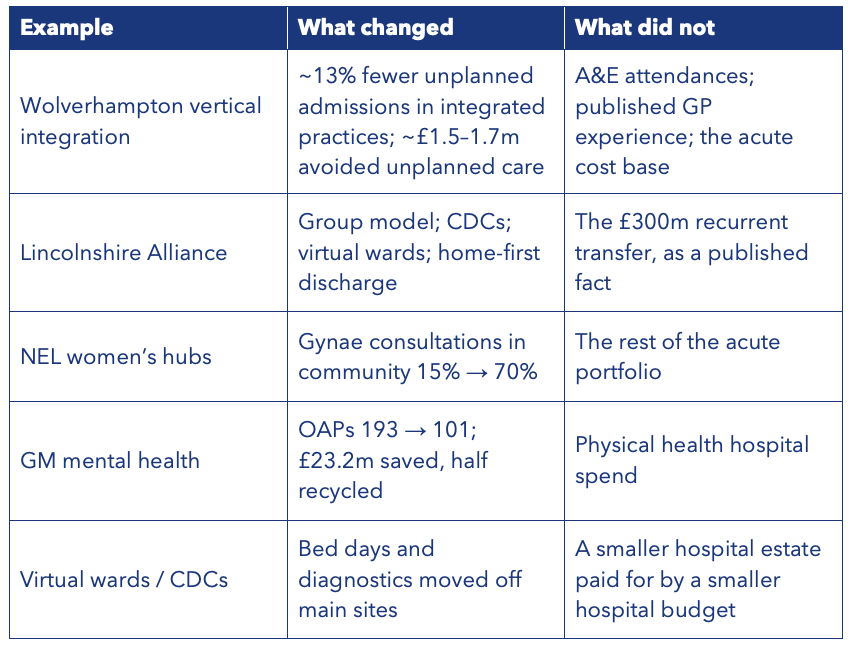
Wolverhampton is, to this author’s mind, the most authentic example of a permanent, beneficial shift, and even that is modest. But it is a sigh of what is possible and sustainable. David Loughton CBE was chief executive of The Royal Wolverhampton NHS Trust from 2004 until April 2024, after an earlier long spell at Coventry. He was, by the end, the longest-serving NHS chief executive. He is genuinely impressive. Vertical integration of GP practices began in 2016. By early 2018 the trust ran ten of Wolverhampton’s 42 practices.
An independent Midlands evaluation, published in the British Journal of General Practice and produced with the Strategy Unit, found a statistically significant reduction in unplanned admissions of about 0.11 per 100 patients per month: roughly a 13 per cent relative reduction, or about 888 avoided unplanned admissions and 168 readmissions a year in a registered population of 67,402. Estimated savings from avoided unplanned care were about £1.5–1.7 million a year. A&E attendances did not fall. There was no published evidence on GP workload, patient satisfaction or long-term health outcomes.
The trust also built virtual wards, urgent community response, a care coordination centre and community stroke rehabilitation. These sit alongside New Cross Hospital. They have not replaced it. This is not a published re-basing of the acute contract. It is a twenty-year chief executive, a mid-period experiment in owning primary care, and an evaluated dent in emergency admissions. The integration that was measured began twelve years into Loughton’s tenure.
Lincolnshire is the largest stated ambition and the thinnest spend evidence. NHS Confederation has repeatedly quoted a system that looked at an £800 million acute / £200 million community split and set up a Community Alliance to move £300 million of services. United Lincolnshire Hospitals and Lincolnshire Community Health Services formed a Group in April 2024 and have announced an intention to merge. In 2024/25 ULTH income was about £740 million; LCHS about £155 million, with 800,000 community contacts. Virtual wards, community diagnostic centres (more than 250,000 tests since Grantham opened in 2022), urgent treatment centres and home-first discharge are real. An audited movement of £300 million of recurrent hospital spend into community contracts has not been published. Combining the acute and community trusts is a necessary condition for a left shift in a county system. It is not the shift. Without a payment rule that lets money leave the hospital when activity leaves, a Group remains two cost bases under one logo.
The better sectional examples are usable but not sufficient unless scaled up. In North East London, women’s health hubs developed with Barts saw gynaecology consultations outside hospital rise from 15% to 70% of the total. That is an impressive and genuine pattern change but thus far in one specialty. It is not a transformation of a hospital group. Greater Manchester’s shared fund for acute inpatient mental health reduced out-of-area placements from an average of 193 in 2024 to 101 by February 2026, with reported savings of £23.2 million in 2025/26, half reinvested in community and crisis services. That is the cleanest large-system example of money following the patient in one care group, using a mechanism (the out-of-area premium) that creates a visible pot to recycle. Medical and surgical bed bases do not offer the same pot.
Virtual wards, community diagnostic centres, Pharmacy First and neighbourhood hubs change activity and can save some bed days. England reported 12,588 virtual ward beds in October 2025. They have not rewritten allocations.
One to watch, rather than one to cite as done, is the Northern Care Alliance’s cost improvement programme of almost £200 million over three years, focused on GIRFT and moving services into the upper quartile, accompanied by a remodelling of care groups away from site-based leadership to network clinical leadership. The ICB and the regional office have agreed the plan. At the time of writing it is only a few months into a 36-month programme. It is the most genuinely clinically driven CIP of this scale that I have seen. If this can be nurtured to work there will be much for others to learn from as GIRFT has an evidence-based of released resources. NCA has a myriad of other much publicised problems it is working through too and is out for a new chief executive but to my mind their plan is the right one. I hope the CIP is seen through and proves successful.
How to read the evidence without fooling ourselves
What boards should take from this
Do not design the next two years as if a single rating or a single letter from a regulator will close the story. Design them as the first part of a ten-year leadership promise. Treat relapse as the default and prepare for this accordingly. Build the quality management system so that a bad inspection at one site cannot again become a whole-board surprise. System leaders and regulators should model support and restraint. They should avoid an Admiral Byng reaction - the English habit, as Voltaire had it, of shooting an admiral from time to time to encourage the others. It looks decisive. It rarely changes how the next ship is sailed.
It is important to centre on this chief executive and chair question. Without sustainable leadership, change does not hold. Separate the quality climb from the financial climb. Both are required. Neither substitutes for the other. Use partnership for fragile specialties without pretending that is the same as whole-organisation recovery.
On the left shift, I hope the hard work that has gone into the Lincolnshire £300 million story ends with actually making the left shift happen but the jury is out until the money can be shown to have moved. Promise specific pathway transfers with denominators: gynaecology, MSK, diabetes, frailty, stroke rehabilitation, mental health out-of-area placements if relevant. If a genuine shift is wanted, the payment rule has to change first. Otherwise every successful community scheme is an extra cost and the hospital remains full. Neighbourhood teams and community diagnostics are the right building blocks. They are not, by themselves, a new operating model.
Wolverhampton is the intriguing tale that is also the best available proof of concept: own more of primary and community care, stay long enough to make it boring, evaluate the admissions effect, and still expect the hospital to be there in the morning.
The English evidence is that large organisations do come back from failure. They come back slowly. They often slip along the way. The ones that hold the line have stable leadership and a board that is more concerned by another avoidable death than of another snitty letter from a minister. Morecambe Bay is the honest comparator: maternity can be Good again after Kirkup and whilst the organisation is still Requires Improvement. This shows the work is not yet finished but that change that lasts has been made.
There is still no large provider that has moved a meaningful share of hospital money into community care in a way that would survive tough finance committee scrutiny. There are specialties and cohorts where the pattern of care has changed, and one twenty-year chief executive who made a meaningful, evaluated dent in emergency admissions by picking up some of general practice. If a left shift is wanted, pick the pathways, change the money and plan in decades, not in the life of a special measures report.
Sources (selected)
CQC, Driving Improvement: Case studies from eight NHS trusts (2017); CQC provider pages and inspection reports for UHMBT, ELHT, CUH, Tameside and BHRUT; Kirkup, The Report of the Morecambe Bay Investigation (2015); Niche Health and Social Care Consulting, independent investigation into urology services at UHMBT (2021).
Yu V et al., “Hospital admissions after vertical integration of general practices with an acute hospital”, British Journal of General Practice 2020; 70(699): e705–e713 (https://bjgp.org/content/70/699/e705); Strategy Unit commentary on the same evaluation.
NHS Confederation, Is the left shift mission impossible?; Lincolnshire Health Scrutiny and group papers (2024/25); GOV.UK 10 Year Health Plan (July 2025); GMMH announcements on out-of-area mental health savings (2026); Monitor, Moving healthcare closer to home (2015).
Figures are drawn from published regulator, trust, ICB, Confederation and government sources current to August 2026. Several left-shift pound figures are self-reported and have not been independently audited. Ratings change; this is a briefing, not a live dashboard.