
Settlement agreements and senior staff exits: what charity boards must consider
03 September 2026
Andrew Corbett-Nolan explains how charity boards should handle settlement agreements and senior staff exits, balancing employment law, trustee duties, financial stewardship and reputational risk.
Points raised in this article
- Settlement agreements can reduce legal and reputational risk.
- Trustees must retain oversight and act in the charity’s interests.
- Senior exit decisions need legal advice and clear documentation.
- Enhanced payments require particular care and proper justification.
Strong governance reduces employment, regulatory and reputational risk.
Senior staff exits are among the most sensitive decisions a charity board will face. When the relationship with a chief executive or other senior leader breaks down, whether through performance concerns, strategic differences, conduct issues or simply a loss of confidence, the temptation to move quickly can be strong. Yet a poorly handled exit can expose the charity to Employment Tribunal claims, regulatory scrutiny and reputational damage.
Settlement agreements are frequently the preferred route for senior exits. Done well, they provide certainty, minimise disruption and protect the charity’s interests. Done poorly, they can leave trustees open to criticism from the Charity Commission and questions about the proper use of charitable funds.
This article sets out the key considerations for charity boards when using settlement agreements in senior staff exits.
Why settlement agreements are common for senior exits
A settlement agreement is a legally binding contract under which an employee agrees to waive their right to bring most employment-related claims (including unfair dismissal, discrimination and breach of contract) in return for an agreed package.
For senior roles, in terms of simple risk management, they are often preferable to a contested process because they:
- reduce the risk of a public Employment Tribunal hearing
- allow a managed handover and controlled communications
- can preserve relationships and the individual’s dignity
- provide finality for the charity and the staff member concerned
However, trustees must remember that a settlement is not simply a commercial negotiation. It involves the application of charitable funds and must be justified as being in the charity’s best interests.
Trustee duties that apply
Trustees have a legal duty to act in the best interests of the charity, to protect its assets, and to exercise reasonable care and skill. These duties apply fully to decisions about senior exits and any associated payments.
Key points include:
- the board (or a properly authorised committee) should retain oversight of significant exits. Leaving the process solely to the chair or remaining executives creates risk
- decisions must be properly informed. Trustees should receive and consider clear legal advice on the strength of any potential claims, the likely costs of defending them, and the risks of proceeding without a settlement
- the decision-making process should be recorded. Minutes should show that trustees considered the options, the advice received, the financial implications and why the proposed package was in the charity’s interests
- conflicts of interest must be managed. Personal relationships or previous involvement in performance management can compromise objectivity
The Charity Commission has previously issued an official warning to a major charity where trustees failed to ensure they were sufficiently informed before approving a significant settlement and did not act with reasonable care and skill during negotiations. The size of the payment was a material factor in the Commission’s criticism.
The process: protected conversations and without prejudice discussions
Most senior exits begin with an off-the-record discussion. Two main routes exist:
- Protected conversations (section 111A of the Employment Rights Act 1996) allow an employer to open discussions about ending employment even where no formal dispute exists. These conversations are generally inadmissible in ordinary unfair dismissal claims, but the protection does not extend to discrimination, whistleblowing or automatic unfair dismissal claims.
- Without prejudice discussions apply where there is already an existing dispute.
Boards should ensure that anyone conducting these conversations understands the limits of the protection and that improper behaviour (undue pressure, discriminatory comments, etc.) can destroy it.
Structuring the financial package
A typical senior settlement package may include:
- notice pay (or payment in lieu of notice)
- accrued but untaken holiday
- an ex-gratia or compensation payment
- contribution to the employee’s legal fees
- agreement on a reference and internal/external announcements
- arrangements for garden leave, restrictive covenants and return of property
Contractual entitlements (notice, holiday, etc.) are normally straightforward. Enhanced or ex-gratia elements require more care.
Under the updated rules that took effect in November 2025 (Charities Act 2022), charities can make certain smaller “moral” or ex-gratia payments without Charity Commission authority, provided the governing document does not prohibit them and the payment falls within income-based thresholds:
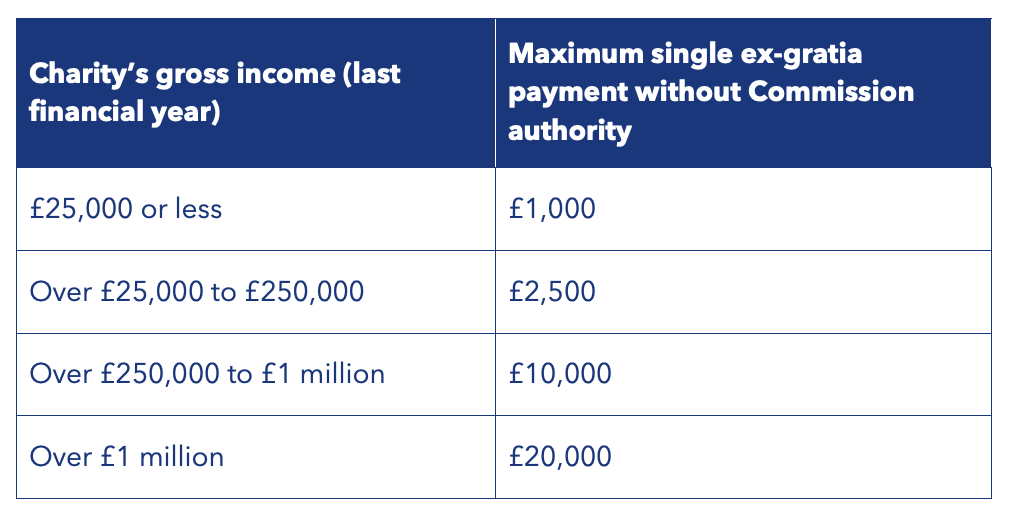
Larger payments, or those that cannot be justified as being in the charity’s best interests, may still require Commission authority or careful documentation showing why the payment meets the legal tests.
Trustees should distinguish clearly between:
- payments that discharge a legal liability or settle a genuine claim (usually justifiable as being in the charity’s interests because they avoid the cost and risk of litigation)
- purely moral or enhanced payments that go beyond legal entitlements
Practical steps for boards
- Take specialist advice early Instruct employment lawyers with charity sector experience at the outset. Legal advice attracts privilege and helps protect the decision-making process
- Assess the risks properly Obtain a clear assessment of potential claims, their strength, likely value and the costs of defending them. Factor in reputational risk and management time
- Keep the board informed Significant exits should not be decided by one or two individuals. Ensure the full board (or a properly constituted committee) has the information it needs and records its decision
- Document the rationale Minutes should show consideration of options, advice received, financial impact and why the proposed settlement is in the charity’s best interests
- Handle communications carefully Agree internal and external messaging in advance. Avoid anything that could undermine the settlement or create further risk
- Check governance formalities Confirm who has authority under the articles or scheme of delegation to approve the exit and any payments. Ensure any dual roles (e.g. director and employee) are properly terminated
Common pitfalls to avoid
- approving a large package without proper legal advice or board-level scrutiny
- failing to record the decision-making process
- treating an enhanced payment as automatically justified simply because “everyone does it”
- allowing negotiations to drift without clear parameters or reporting back to the board
- overlooking the need for the employee to take independent legal advice (a requirement for the waiver of claims to be valid)
Conclusion
Settlement agreements can be an effective and responsible way to manage senior staff exits, but they sit at the intersection of employment law and charity law. Boards that approach them with clear process, proper advice, documented decision-making and a focus on the charity’s best interests significantly reduce both legal and regulatory risk.
Trustees do not need to become employment law experts, but they do need to ensure that the charity’s approach is disciplined, informed and defensible. In this area, good governance is the best protection.
Further reading
- Charity Commission: How charities can make a moral, or ‘ex gratia’, payment (CC7)
- Charity Commission: Charities and litigation: a guide for trustees (CC38)
- ACAS guidance on settlement agreements
- Charity Commission guidance on decision-making for trustees (CC27)