
Patients move across pathways, not management structures
21 July 2026
In his first GGi blog, senior consultant James Avery outlines why good governance is key to unlocking safer flow and the next stage of improvement
Points raised in this article:
- Patient delays reflect whole-system failure, not just emergency departments
- Fragmented governance creates gaps in accountability, escalation and safety
- Boards must test whether controls work under sustained pressure
- Shared pathway ownership enables safer flow and lasting improvement
When a patient is stuck in an emergency department corridor waiting for an inpatient bed, the instinct is to look first at the emergency department: staffing levels, waiting times, triage processes and demand. These things matter, but they are not where the problem starts, and they are rarely where it ends.
Once a patient has been assessed, treated and accepted for admission, any further delay is no longer simply an emergency department issue. It tests whether the whole hospital can respond safely, consistently, and at pace and whether governance is joining that response.
In May 2026, NHS England reported 128,590 delays of more than four hours from decision to admit to actual admission, averaging 4,148 patients per day. Of these, 50,212 patients waited more than 12 hours, equivalent to 1,620 patients every day.
These figures need to be read with an understanding of the significant effort of clinical teams working under sustained pressure. There are signs of improvement: in May 2026, the number of attendances admitted, transferred or discharged within four hours was 2.9% higher than in May 2025, and all-type four-hour performance was slightly higher than the previous year. But the same data show that over-12-hour decision-to-admit delays were 17.1% higher than in May 2025. Progress is real; it is also fragile.
Governance shortcomings
The point, therefore, is not to criticise hard-working staff. It is to ask whether hospital and wider system governance is sufficiently mature to support them, manage shared risk and make improvement sustainable.
These figures matter because they describe the point at which the wider hospital’s ability to respond safely, consistently and at pace is tested. The delay after a decision to admit is not simply about emergency department demand; it is about whether the whole organisation can manage shared risk.
The risk is not theoretical. Longer waits in emergency departments have been associated with poorer outcomes, including increased mortality. Recent reports of sepsis-related deaths in an overcrowded emergency department have also shown how crowding can weaken the reliability of basic safety processes: sepsis screening, senior review, antibiotics, fluids, observations, investigations and escalation. This is a governance issue in its clearest form.
Overcrowding does not simply make care uncomfortable or inefficient. It creates conditions in which normal safety controls become harder to deliver reliably. A sepsis protocol on its own is not assurance. A dashboard showing long waits is not assurance. Assurance comes from knowing whether those controls still work when the department is crowded, patients are waiting in non-standard areas, staff are stretched, and admitted patients remain in ED because inpatient capacity has not been released.
In many hospitals, emergency departments sit within one division or management structure, while acute medicine, speciality wards, diagnostics, discharge teams, site operations and executive oversight sit elsewhere. The patient experiences one hospital, but the risk can be divided across several teams, committees and reporting lines.
Closing the governance gap
The patient waiting in ED for admission is not only waiting in a department. They are waiting in a governance gap, and good governance should work to close that gap.
This requires boards, executive teams and clinical leaders to move beyond asking whether the organisation has an urgent and emergency care dashboard. The more important question is whether there is a live, cross-divisional risk management system that works in practice.
These questions matter because delayed admission is often the point at which fragmented governance becomes visible. ED may be physically holding the patient, but the controls needed to reduce the risk sit across the whole organisation and wider system. The medical ward with no beds, the speciality team that has not yet reviewed, the diagnostic pathway under pressure, the discharge process that has not created capacity, and the site team trying to manage flow are all part of the same risk picture.
Good governance is therefore not simply the production of a better report. It is the creation of a better response.
For boards and quality committees, the core question is not simply ‘Are we meeting the four-hour standard?’ but ‘Can we evidence that patients waiting for admission are safe, reviewed, escalated and treated according to clinical risk?’ That requires knowing where patients are waiting, how long they have been waiting, who is accountable for their care, and whether escalation occurs promptly when risk increases.
For executive teams, the question is: ‘Are our divisions working together with sufficient grip, pace and clarity?’ They might also ask: ‘Do we have clear ownership across pathways?’ and ‘Can we act quickly when pressure shifts between teams?’
Clinical teams should ask themselves: ‘Do our protocols protect patients when the system is under pressure?’ And also: ‘Are staff supported to apply those protocols consistently?’ and ‘Do we know when protocol reliability is weakening?’
For quality committees, the question is: ‘Can we evidence that the controls we rely on are actually working?’ Further questions are: ‘Do we test those controls in real conditions?’ and ‘Can we show what changes when they do not work as intended?’
Collective action
Addressing this risk requires governance that is strong in practice, not just in structure. It is not enough for ED to report crowding, medicine to report bed pressures, operations to report flow, and the board to receive separate dashboards. Boards must test their assurance and the extent and effectiveness of partnership working on these risks
The best organisations treat emergency demand as a shared safety task. A crowded emergency department is a signal that a system is under pressure and needs to respond not merely as a single department. In the north of England, Bury care organisations are working together, as part of an active case management process which has produced one of the lowest avoidable ED attendances in the region. Asking the right questions is key to this success. Partnership working prevents avoidable attendance, supports timely discharge and scales community capacity when pressure rises.
Patients move across pathways, not management structures, and risk moves with them. Good governance ensures that accountability, escalation, and improvement move with them, too, and that no patient is left waiting in the gaps between organisations or services.
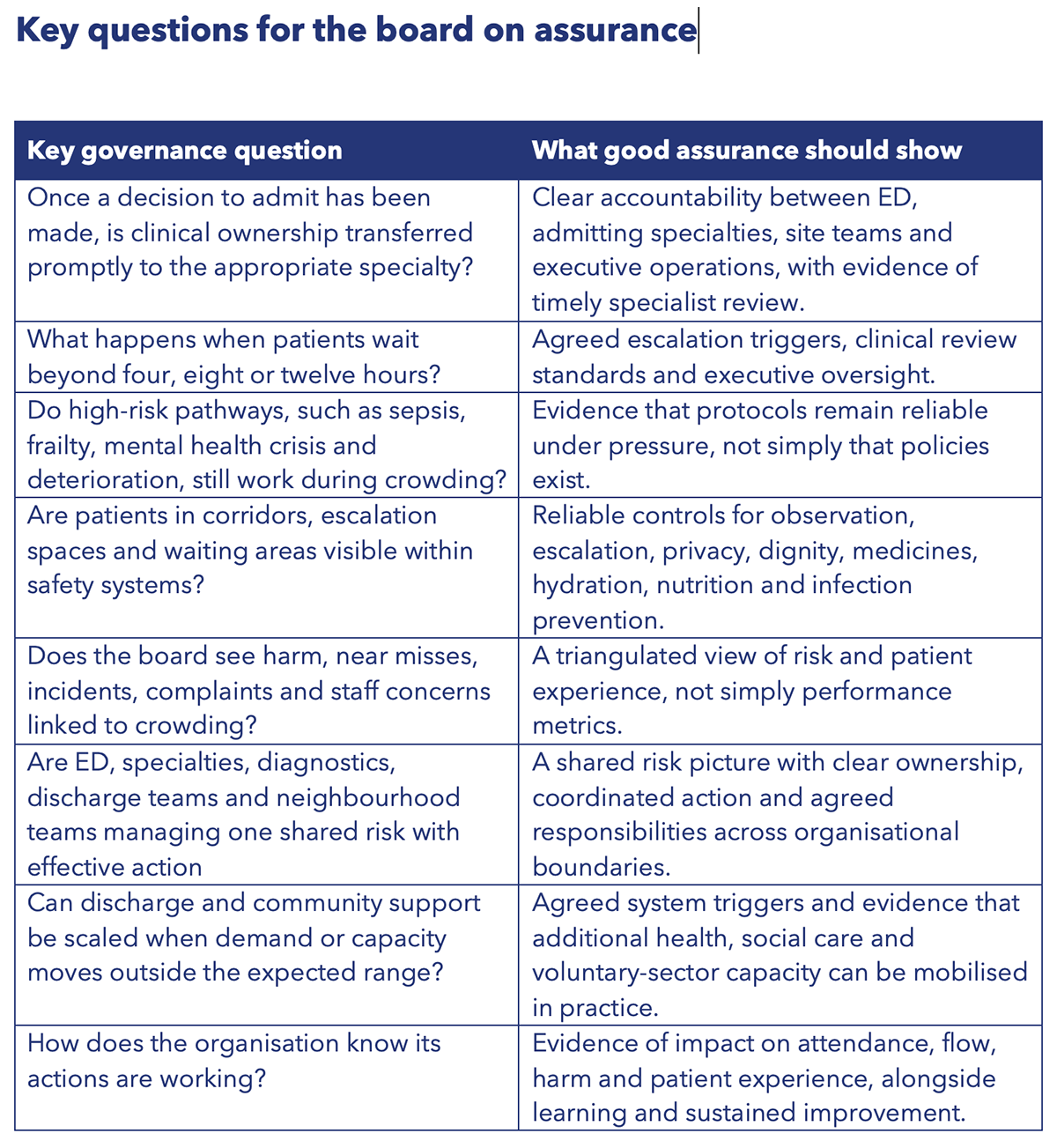
That shared response can be tested through a number of practical assurance questions.
References
Care Quality Commission (2025) Regulation 17: Good governance. Available at: https://www.cqc.org.uk/guidance-regulation/providers/regulations-service-providers-and-managers/health-social-care-act/regulation-17 (Accessed: 6 July 2026).
Jones, S., Moulton, C., Swift, S., Molyneux, P., Black, S., Mason, N., Oakley, R. and Mann, C. (2022) ‘Association between delays to patient admission from the emergency department and all-cause 30-day mortality’, Emergency Medicine Journal, 39(3), pp. 168–173. doi: 10.1136/emermed-2021-211572. Available at: https://emj.bmj.com/content/39/3/168 (Accessed: 6 July 2026).
NHS England (2026a) A&E attendances and emergency admissions for May 2026. Available at: https://www.gov.uk/government/statistics/ae-attendances-and-emergency-admissions-for-may-2026 (Accessed: 6 July 2026).
NHS England (2026b) A&E Attendances and Emergency Admissions 2026–27. Available at: https://www.england.nhs.uk/statistics/statistical-work-areas/ae-waiting-times-and-activity/ae-attendances-and-emergency-admissions-2026-27/ (Accessed: 6 July 2026).
NHS England (2026c) Proposed section 106 enforcement undertakings: Hull University Teaching Hospitals NHS Trust. Available at: https://www.england.nhs.uk/wp-content/uploads/2026/02/proposed-s106-enforcement-undertakings-hull-university-teaching-hospitals-nhs-trust.pdf (Accessed: 6 July 2026).
Nursing Standard (2026) ‘Sepsis: “significant” overcrowding in ED linked to two women’s deaths’, Nursing Standard. Available at: https://www.nursingstandard.com/ [Full article details to be confirmed from RCNi/Nursing Standard access] (Accessed: 6 July 2026).
Office for National Statistics (2025) Association between time spent in emergency care and 30-day post-discharge mortality: England, March 2021 to April 2022. Available at: https://www.gov.uk/government/statistics/association-between-time-spent-in-emergency-care-and-30-day-post-discharge-mortality-england-march-2021-to-april-2022 (Accessed: 6 July 2026).
Royal College of Emergency Medicine (2026) ‘How many deaths will it take before we see a meaningful plan to end the crisis?’: Deaths associated with long ED waits surge almost tenfold over a decade. Available at: https://rcem.ac.uk/press-release/how-many-deaths-will-it-take-before-we-see-a-meaningful-plan-to-end-the-crisis-deaths-associated-with-long-ed-waits-surge-almost-t/ (Accessed: 6 July 2026).
Bury Integrated Neighbourhood Teams. Video presentation via https://vimeo.com/1192181988?share=copy&fl=sv&fe=ci