
From data to insight
16 October 2026
GGi senior consultant James Avery asks what constitutes a good integrated quality report – how mature is yours?
Points raised
- Good quality reports turn data into insight that drives change
- Triangulated evidence explains not just what changed, but why.
- Insight must reach the frontline teams who can act.
- A seven-step test and maturity matrix show where to improve.
Florence Nightingale used diagrams to make preventable deaths intelligible to decision-makers. [1]
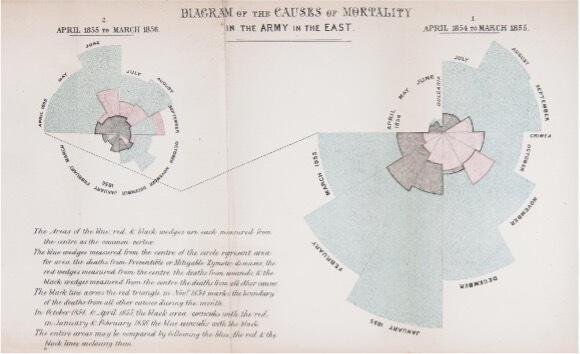
Ernest Codman's end-result idea followed patients to ask whether treatment worked and, if not, why not. [2] Their achievement was not more data but insight that led to change.
How can today's NHS boards do the same with vastly more information?
An integrated quality report (IQR or IQPR) connects clinical quality, experience, workforce, operations, risk and improvement. It is not every metric in one pack; it helps teams and boards judge whether services are safe, effective, caring, responsive and well-led, where assurance is limited and what must happen next.
National expectations: from metrics to meaningful insight
The National Quality Board defines quality through safety, effectiveness and experience and asks providers to plan, monitor, improve and assure it using national and local data at the right level. [3] The Insightful Provider Board adds the method: identify variation, triangulate signals, benchmark, use SPC and explain patterns, causes and actions. [4]
The 2026/27 NHS Oversight Framework provides a national spine of scoring and contextual metrics across access, outcomes, experience, safety, finance, productivity and people. [5] But it is not an integrated report. Providers must connect those measures to local priorities, risks and qualitative intelligence to show what is happening, why it matters and where action is required.
The CQC lens: information must support decisions
CQC reinforces this: organisations should "act on the best information about risk, performance and outcomes". [6] Earlier guidance states that "integrated reporting supports effective decision making". [7] These test whether leaders can see risk, challenge interpretation and track impact - not formatting.
Recent CQC inspection reports show us the challenges. At one provider, it was noted that reporting shifted from counts to themes, learning, and actions. At another, however, IQPRs and real-time systems did not consistently turn known risks into action. Reports only really add value when they help teams and boards notice early warning signs, understand what may be driving them and act.
National guidance is clear: triangulate metrics with patient, workforce and operational intelligence, and present it where people can act. [3][4] As such, every section should answer five questions:
- What changed?
- Am I seeing quality, workforce, operational, financial and experience evidence triangulated to explain the likely influences and drivers?
- What action is underway?
- What support or escalation is needed?
- How assured are we, and where is confidence limited?
GGi teams used this approach supporting one provider, combining a focused national metric spine with local risks and priorities across safe, effective, caring, responsive and well-led. The result gave clear insight and showed existing improvement priorities, which were valuable but didn’t fully address the greatest need. The report changed the conversation from receiving information to exercising judgement.
Insight must reach the teams that can act
Integrated intelligence is not only for the board. Clinical teams, specialty and divisional leaders need the same triangulated view to investigate signals against practice and act immediately. Their interpretation strengthens insight and the narrative for committees and the board. One team GGi spoke to recently identified a rise in medication errors from rapid, detailed and triangulated reporting. Visiting the clinical areas revealed equipment problems, which were quickly corrected.
What should boards do?
An IQPR is a core instrument of board oversight and accountability. NHS boards are responsible for ensuring that the healthcare and other services provided by the trust are high quality and safe. The report should therefore demonstrate how the board is sighted on quality, safety, experience, workforce, operational performance and risk.
The report should also connect national requirements, strategic priorities and principal board assurance framework risks and show how the quality impact of board-approved decisions is being monitored.
The seven steps below provide a practical test of whether the report supports oversight, triangulation, judgement and action.
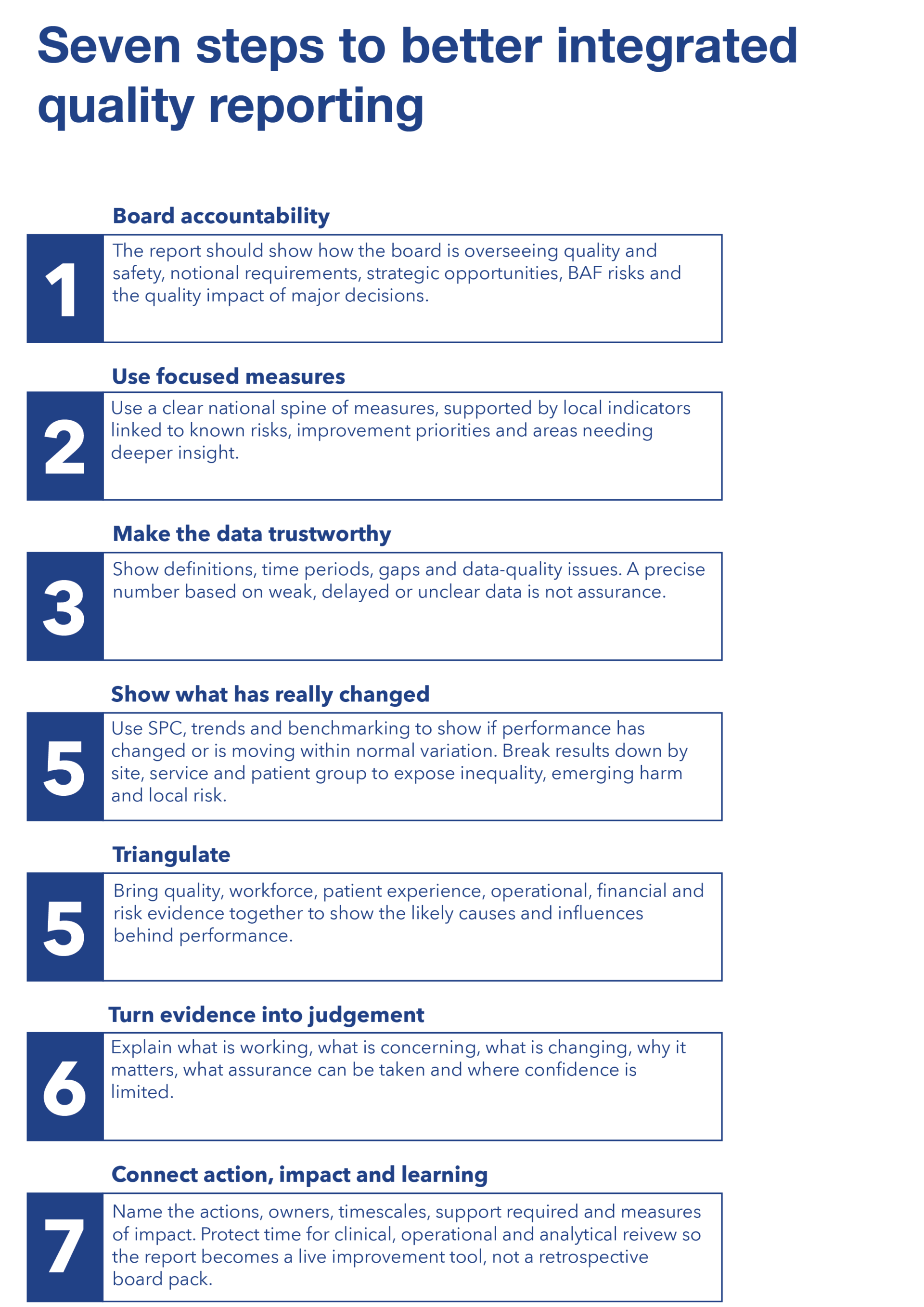
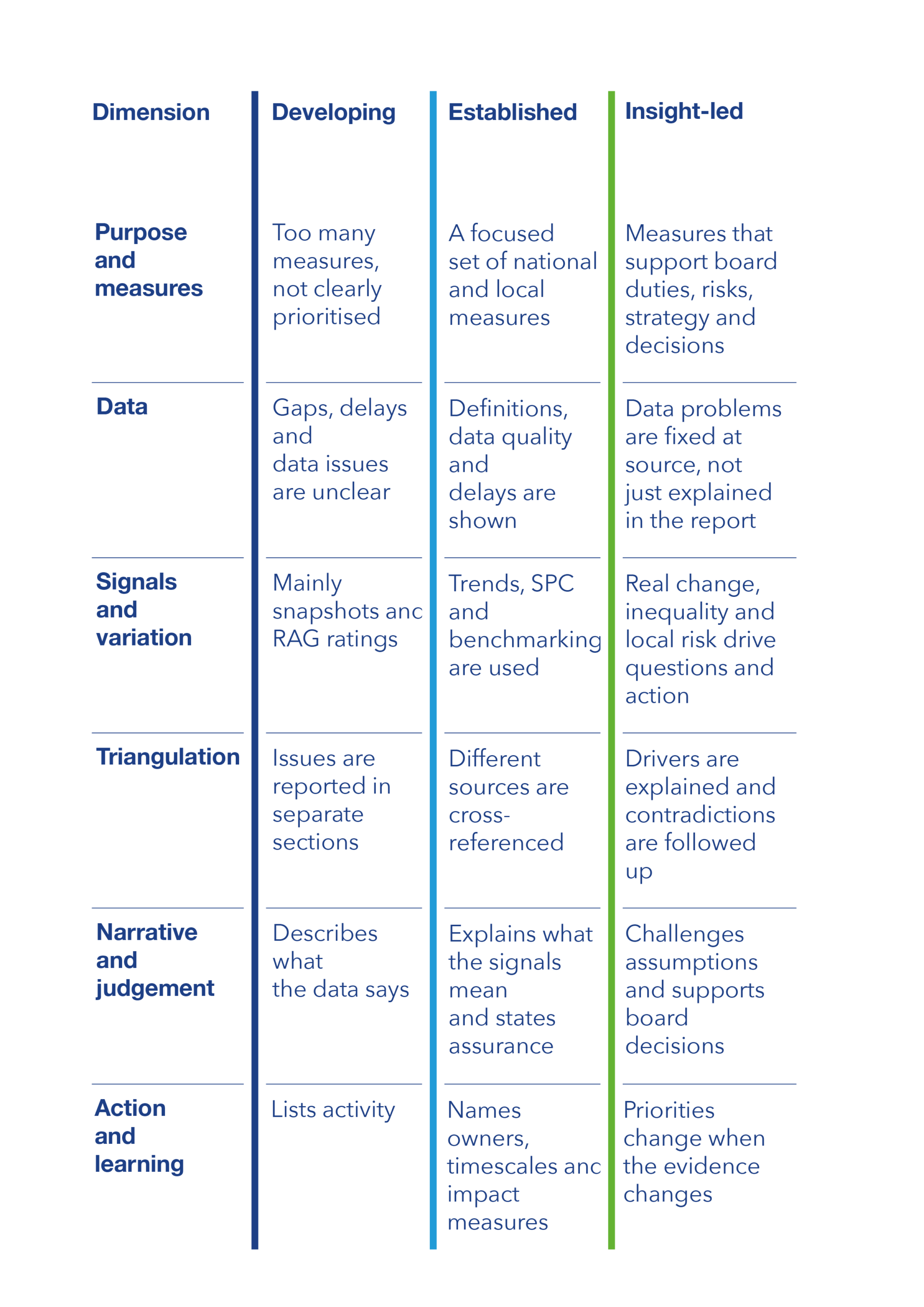
Considering the depth of these 7 steps, the maturity matrix below helps to consider whether a quality report is mainly describing data, beginning to explain assurance, or genuinely supporting insight-led judgement and action. It can identify where the report needs to mature next:
From reporting to improvement
Done well, integrated quality reporting gives boards a clearer line of sight from service to board, strengthens committee assurance and creates earlier opportunities to act. It can also support CQC Well-led evidence, but its real value lies in how it is used: to test assurance, understand risk, support & resource teams and inform priorities. This connection of data, experience and risk help boards and clinical teams ask better questions, focus on the areas of greatest need and understand whether improvement is making a difference.
For boards, the task is to assess the maturity of their current reporting arrangements and build the capability to improve them. Nightingale and Codman’s tests still apply: did information generate insight, and did insight lead to change?
Statistical Process Control (SPC) note:
If unfamiliar, this short guide explains variation and early signals: NHS England SPC guide
References
[1] Science Museum Group (n.d.) Florence Nightingale: the pioneer statistician. Available at: https://www.sciencemuseum.org.uk/objects-and-stories/florence-nightingale-pioneer-statistician (Accessed: 14 August 2026).
[2] American College of Surgeons (n.d.) Ernest A. Codman, MD, FACS (1869–1940). Available at: https://www.facs.org/about-acs/archives/past-highlights/codmanhighlight/ (Accessed: 14 August 2026).
[3] National Quality Board (2026) Quality strategy for NHS-funded care in England. NHS England. Available at: https://www.england.nhs.uk/publication/quality-strategy-for-nhs-funded-care-in-england/ (Accessed: 14 August 2026).
[4] NHS England (2024) The insightful provider board. Available at: https://www.england.nhs.uk/long-read/the-insightful-provider-board/ (Accessed: 14 August 2026).
[5] NHS England (2026) NHS Oversight Framework 2026/27. Available at: https://www.england.nhs.uk/publication/nhs-oversight-framework-2026-27/ (Accessed: 14 August 2026).
[6] Care Quality Commission (n.d.) Single assessment framework: Well-led – Governance, management and sustainability. Available at: https://www.cqc.org.uk/guidance-regulation/providers/assessment/single-assessment-framework/well-led/governance-management-sustainability (Accessed: 14 August 2026).
[7] Care Quality Commission (n.d.) Management of information: good. Available at: https://www.cqc.org.uk/guidance-providers/healthcare/management-information-good (Accessed: 14 August 2026).
[8] NHS England (n.d.) Service-level demand and capacity planning: Statistical Process Control (SPC). Available at: https://www.england.nhs.uk/ourwork/demand-and-capacity/service-level-demand-and-capacity-planning/ (Accessed: 14 August 2026).