
Choosing your form: legal models as governance decisions
06 May 2026
Daniel Taylor suggests being strategic and deliberate in choosing your organisation’s legal form
Points raised in this article
- Most public-purpose organisations inherit their legal form and spend little time thinking about it.
- But form is not neutral; it shapes power, accountability, culture and behaviour.
- So, it is worth being aware of the relative strengths and weaknesses of different legal forms.
- It is also worth periodically questioning whether your organisation’s legal form is the right one.
“Form is never more than an extension of human purpose.”
— Madeleine Albright
Boards of public-purpose organisations often inherit their legal form. Articles are adopted, constitutions amended, registrations filed and then quietly forgotten. Legal form becomes background architecture: important, certainly, but assumed to be settled.
This is understandable. Legal form is usually encountered through lawyers, regulation and compliance. It is framed as a technical question, best handled by specialists, and revisited only when something breaks.
Organisations, like people, express their priorities through the structures they adopt. Legal form is not a set of filings and articles hidden in governance manuals; it is the architectural frame that shapes how power flows, how accountability works and how purpose is protected over time. Boards should therefore treat form as a strategic choice, not a technicality. In doing so, they align with governance fundamentals, where clarity of roles, accountability and stakeholder legitimacy are core principles, not optional add-ons.
But legal form is not neutral. It shapes power, accountability, risk, culture and behaviour. It defines who the organisation exists for, how decisions are taken, and what happens when things go wrong. From a governance perspective, choosing and living with a legal form is not a technical exercise; it is a strategic one.
This article therefore offers a governance-led guide to common legal forms used by public-purpose organisations, exploring each form’s strengths, constraints and implications. It is not legal advice and it does not attempt to describe the law in detail. Instead, it asks a different question: what kind of governance does this form enable, and what kind does it make harder?
Legal form as a governance signal
At its simplest, legal form answers three fundamental governance questions:
- Who ultimately holds power?
- To whom is the organisation accountable?
- How is purpose protected over time?
Different models answer these questions differently. Some prioritise member control, others embed independence. Some emphasise stewardship and public trust, others flexibility and entrepreneurialism.
In GGi’s articulation of core governance principles, accountability and clarity of roles are fundamental to effective governance. Boards must know who holds authority, to whom the organisation is accountable, and how stakeholder interests are understood — questions that are shaped directly by the organisation’s legal form.
Boards that fail to engage with these choices often find themselves frustrated later – constrained by rules they did not fully understand or exposed to risks they did not anticipate. Good governance begins by recognising that form shapes behaviour long before it shapes compliance.
Charitable models: trust, restraint and public confidence
Charitable status remains attractive for many public purpose organisations because of the clarity it brings around mission and public benefit.
From a governance perspective, charities offer:
- strong purpose lock, enforced by charity law and regulation
- high public trust and legitimacy
- clear fiduciary duties focused on beneficiaries and public benefit.
These features support stewardship-oriented governance. Trustees are guardians, not owners. Decisions are framed in terms of long-term benefit rather than short-term gain.
However, this strength can also become a constraint. Charity governance can feel cautious, especially where boards conflate prudence with risk aversion. The regulatory environment can reinforce a culture of compliance over experimentation. Hybrid or commercial activity often sits uncomfortably within charitable forms unless carefully structured.
For boards, the key governance question is whether the organisation’s strategy genuinely aligns with the discipline and restraint that charitable status brings, or whether tensions are being papered over.
Companies limited by guarantee: flexibility with responsibility
Companies limited by guarantee are widely used across education, culture, housing and social enterprise. They offer a familiar corporate structure without shareholders seeking profit.
Governance advantages include:
- clear separation between members and directors
- flexibility in constitutional design
- well-understood decision-making and liability frameworks.
This model often suits organisations that operate at scale, manage complexity, or engage in trading activity while retaining a public purpose.
From a governance perspective, however, much depends on how membership is designed. Members can be a meaningful accountability mechanism or a distant formality. In poorly designed models, the company form can drift towards managerialism, with boards becoming self-perpetuating and accountability becoming opaque.
The governance challenge here is intentionality: designing membership, reporting and engagement so that the organisation remains anchored to purpose rather than convenience.
Community benefit societies and cooperatives: democracy and discipline
Community benefit societies and cooperatives embed democratic principles into their legal DNA. They are explicitly designed to serve members or communities, often with asset locks and limits on private benefit.
Governance strengths include:
- strong alignment between users, members and purpose
- visible accountability to a defined community
- resistance to mission drift and capture.
These models can be powerful where legitimacy depends on participation and collective ownership.
The governance challenge is that democracy is demanding. Large or disengaged memberships can weaken rather than strengthen accountability. Boards must work harder to balance representation with competence, and participation with effectiveness. Decision-making can be slower, and strategic coherence harder to maintain.
For boards considering or operating within these forms, the question is not whether democracy is desirable, but whether the organisation has the capacity and culture to sustain it well.
Statutory and public body forms: authority and constraint
Statutory bodies, non-departmental public bodies and similar forms derive their authority directly from legislation or government mandate.
Their governance strengths are clear:
- strong legitimacy and public authority
- clear accountability to ministers, parliament or the public
- formal clarity of role and purpose.
But statutory form often comes with heavy constraint. Autonomy is limited; accountability is multi-layered. Boards can struggle to reconcile stewardship of the organisation with responsiveness to political direction.
From a governance perspective, learning becomes critical. Boards must navigate ambiguity, manage competing accountabilities and avoid becoming either purely advisory or purely defensive. Legal form does not remove these tensions; it institutionalises them.
Hybrid and group structures: managing complexity consciously
Many public-purpose organisations now operate through groups: charities with trading subsidiaries, companies with charitable parents, joint ventures and partnerships. From a governance standpoint, hybrid structures can offer the best of multiple worlds: protection of purpose alongside commercial flexibility.
They also introduce risk:
- blurred accountability
- uneven governance capability across entities
- over-reliance on a small number of individuals who understand the structure.
Boards overseeing such models must govern the whole system, not just the parent entity. Legal form choices multiply governance responsibilities rather than simplify them.
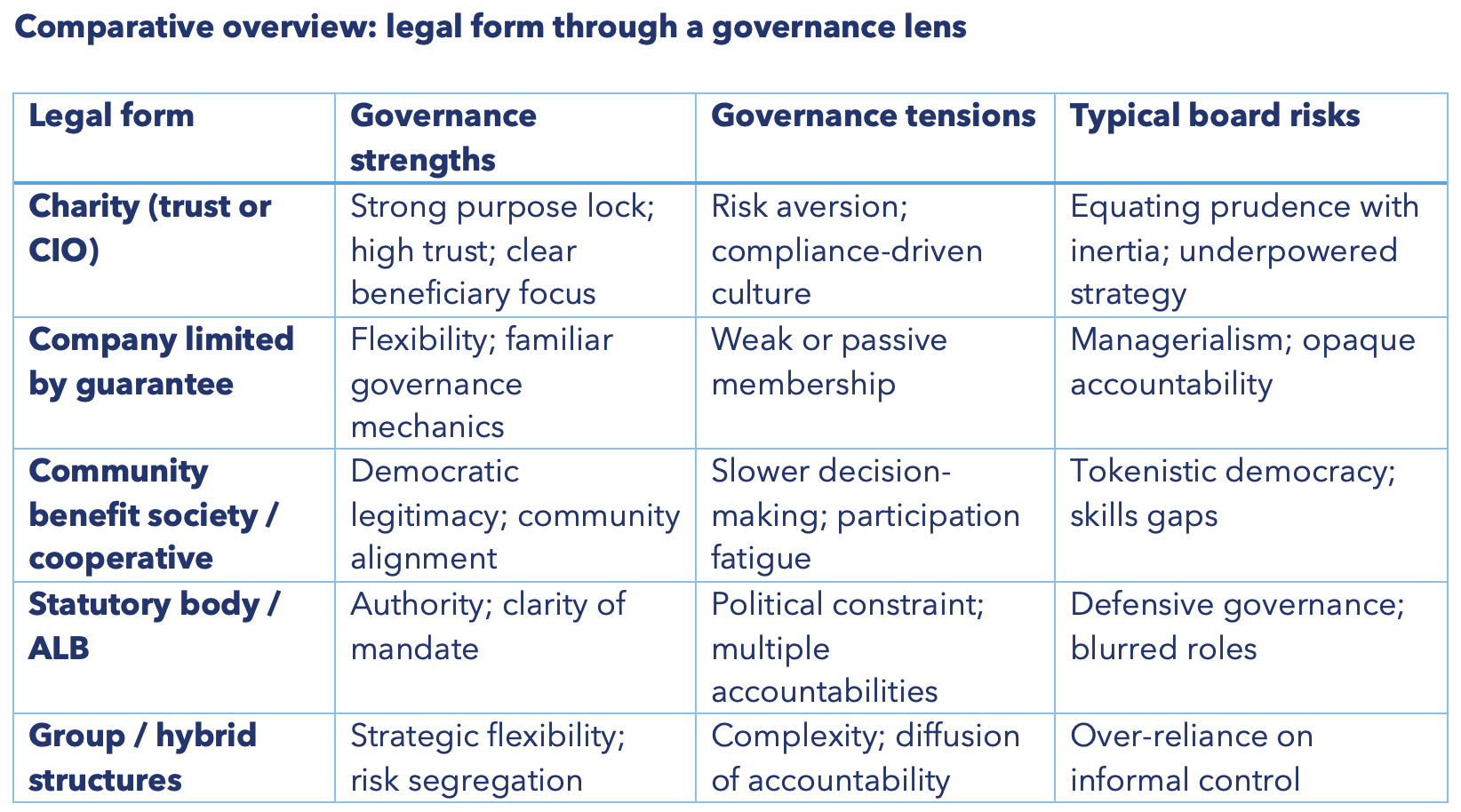
This table is not a recommendation nor a checklist. It is intended to help boards surface trade-offs explicitly, rather than discovering them by accident.
Subsidiaries: governance leverage or governance blind spot?
Subsidiaries deserve special attention, because they are often created for sensible reasons but governed casually.
Wholly owned subsidiaries, trading arms and special purpose vehicles are usually established to manage risk, enable commercial activity or comply with regulatory boundaries. From a governance perspective, however, they introduce a second governing system alongside the first.
Common assumptions are that:
- ownership equals control
- shared directors guarantee alignment
- group strategies naturally translate into subsidiary behaviour.
None of these is reliably true.
Subsidiaries have their own legal duties, financial realities and risk profiles. Directors wear different hats, sometimes simultaneously. Reporting lines become blurred. Informal influence substitutes for formal accountability. Over time, boards may lose sight of where decisions are actually being taken.
Good governance of subsidiaries requires conscious design:
- clarity about what decisions sit where
- explicit articulation of risk appetite across the group
- disciplined information flows, not just consolidated accounts
- boards that understand the system, not just the parent entity.
From a governance perspective, subsidiaries are not merely technical solutions. They are amplifiers of both good and poor governance. They reward clarity and punish complacency.
Choosing and reviewing form as a board
From a governance perspective, boards should periodically ask themselves:
- Does our legal form still serve our purpose, strategy and operating reality?
- What behaviours does our form encourage or discourage?
- Where does power really sit, and is that where we think it sits?
- Are we clear about who we are accountable to, and how?
These are not legal questions, though legal advice will often be needed to act on them. They are governance questions, rooted in stewardship, effectiveness and legitimacy.
A final caution
Legal form will not save an organisation from poor governance. Nor will it compensate for weak leadership, unclear strategy or dysfunctional culture. But it will amplify whatever governance is already present, for good or ill.
Boards that treat form as a living governance choice, rather than a historic technicality, place themselves in a far stronger position to govern well over time.
And perhaps that is the real lesson: governance does not begin with documents, but neither does it end there.
In common with all our articles, this blog has been reviewed by a second GGi expert