
Brilliant basics: the report cover sheet
15 May 2026
Daniel Taylor says boards devote lots of time to what is in their papers, but less time is spent on how those papers invite thought
Points raised in this article:
- Cover sheets are much more than clerical devices – they are powerful governance tools
- They help boards to read papers as strategic leaders rather than operational managers
- A list of the core components of any good cover sheet
- A template cover sheet for you to use
Report cover sheets (sometimes called front sheets) are often treated as clerical devices: a few headings, a recommendation, a signature. In practice, they are one of the most powerful governance tools.
A good cover sheet frames the board’s role, clarifies the decision or discussion required, and signals how the paper should be read. A poor one leaves board members guessing, defaulting to reassurance or detail-chasing.
This is a governance brilliant basic because it is simple, repeatable and transformative. Done well, it improves the quality of discussion without adding a single page.
What a front sheet is for
From a governance perspective, a cover sheet does four things:
- Clarifies the board’s role in relation to the paper
- Distinguishes decision, discussion and assurance
- Surfaces the governance implications, not just the operational content
- Directs attention to what matters most
Without this, boards can tend to read papers as managers. With it, they read as strategic leaders seeking assurance.
Common failures
Before setting out what good looks like, it is worth naming what goes wrong most often:
- cover sheets that restate the paper rather than interpret it
- recommendations that are either meaningless (“note the report”) or managerial
- risks listed separately, with no connection to the decision being asked of the board
- no indication of what has changed, what is uncertain, or what judgement is required.
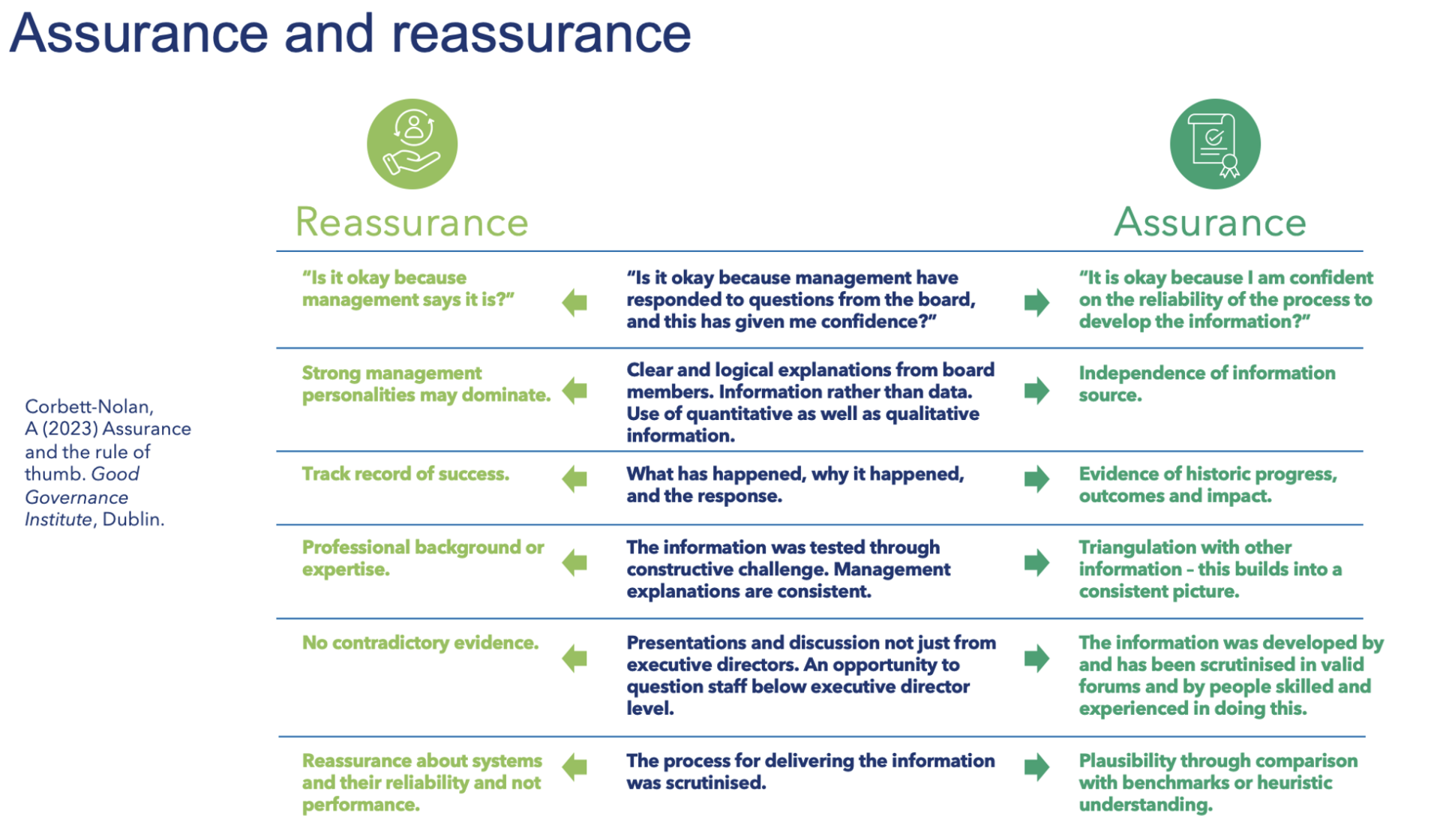
These failures are not about competence; they are about governance intent. Many of these failures stem from confusing reassurance with assurance. GGi’s work repeatedly highlights that governance adds value not by calming boards but by equipping them to test, question and judge with confidence.
The optimal cover sheet: core components
An effective cover sheet should fit on one page and contain the following elements:
1. Purpose of the paper
This should be a single sentence that answers: why is this in front of the board, now?
Not:
“To update the board on…”
But:
“To seek board approval for the proposed approach to X, in light of Y.”
Or:
“To invite board discussion on the strategic implications of Z.”
This anchors the paper in governance time, not reporting routine.
2. Board role
Explicitly state the board’s role in relation to the paper:
- decision
- discussion
- assurance
- noting (used sparingly)
This matters because boards cannot govern well if they are unclear whether they are being asked to decide, shape or test.
3. Executive summary (governance-focused)
This is not a mini version of the paper. It should surface:
- the core issue or choice
- what has changed or triggered the paper
- where judgement is required
If a board member reads nothing else, this section should allow them to participate intelligently in the discussion.
4. Recommendation or proposition
Where a decision is required, the recommendation should be:
- clear
- actionable
- owned
Avoid multiple recommendations unless genuinely necessary. Avoid hedging language that disguises uncertainty rather than naming it. Where discussion is sought, frame this as a proposition or question, not a pseudo-decision.
5. Strategic alignment
A short statement linking the paper to:
- organisational purpose
- strategic objectives
- material priorities
This prevents boards treating papers as isolated events rather than part of a governing narrative.
6. Key risks and implications
This should answer: what should concern the board most if this goes wrong? Limit this to two or three genuinely material risks, linked explicitly to the recommendation or discussion. This is governance, not risk register reproduction.
7. Equality, sustainability and public interest considerations
Where relevant, these should be integrated rather than appended. A sentence that explains how these factors were considered is more valuable than a ticked box.
8. Assurance and next steps
Clarify:
- what assurance the board is being asked to rely on
- what will come back, when, and in what form
This closes the governance loop.
A template cover sheet (example)
Paper title:
Purpose:
To seek board approval for…
Board role:
Decision
Executive summary:
This paper proposes…
Recommendation:
The board is asked to approve…
Strategic alignment:
This supports objective X by…
Key risks and implications:
- Risk 1: …
- Risk 2: …
Public interest / equality / sustainability considerations:
Key considerations include…
Paper path:
Considered at…
Assurance and next steps:
Progress will be reported to…
Committees versus boards: important differences
While the structure of a cover sheet should be consistent, the emphasis should differ. For board papers:
- focus on purpose, trade-offs and system impact
- avoid operational detail unless it informs judgement
- explicitly frame what is being delegated versus retained
For committee papers:
- be clearer about technical depth and limits of authority
- specify escalation routes to the board
- make explicit whether the committee is acting on behalf of the board or advising it
Committees often drift into shadow boards. A good cover sheet helps prevent this by clarifying mandate and boundaries.
The cultural impact
Cover sheets do more than organise papers, they shape effective use of board time and outcomes in the boardroom. Executives learn how to think about governance by how they are asked to present. Boards learn how to govern by how decisions are framed. Over time, a disciplined approach to front sheets creates a shared language of governance: about roles, judgement and accountability.
This is why the cover sheet is a brilliant basic. It is modest, repeatable and quietly transformative.
And like most good governance, it is less about form-filling than about thinking well together.
In common with all our articles, this blog has been reviewed by a second GGi expert