
Further education governance review - method and approach
24 April 2026
Approach
Our approach is developmental, evidence-based and grounded in nearly two decades of practical experience conducting governance reviews across public purpose organisations. Our aim is not simply to assess governance arrangements, but to provide a structured opportunity for reflection and improvement.
We use a well-tested methodology based on triangulated evidence gathering. This combines document review, stakeholder interviews, observation of board and committee meetings, and benchmarking against sector expectations and wider governance good practice. These sources of evidence are analysed together to form a balanced and reliable view of how governance operates in practice.
For your organisation, the review will look beyond governance structures on paper to understand how governance works in reality. This includes examining the quality of board and committee discussions, the balance between information and strategic debate, and the way papers, presentations and assurance processes support effective decision-making and challenge.
Our reviews are designed to be both rigorous and constructive. We provide clear, evidence-based insight into current governance effectiveness while also identifying practical opportunities to strengthen board performance and governance maturity as the organisation moves forward.
Framework of assessment
Our governance review will assess your organisation's governance effectiveness through three complementary lenses: regulatory compliance, governance practice and board effectiveness:
- Regulatory and compliance context
Our assessment will examine how effectively the organisation fulfils the duties and expectations set out in:
- AoC Code of Good Governance – the primary code adopted by the Group.
- Department for Education governance requirements – ensuring compliance with post-16 accountability expectations.
- Charity law obligations – as an exempt charity, adherence to principles of public benefit and trustee duties.
- Nolan Principles of Public Life – ethical standards underpinning governance behaviour. Equality Act 2010 – obligations relating to diversity and inclusion in governance practice
We will also take into account the expectations of the Further Education Commissioner in relation to strong and effective governance.
This assessment will give the Board of Governors a clear and proportionate view of its alignment with both sector codes and statutory obligations, together with practical opportunities to strengthen assurance.
2. Good governance principles and outcomes
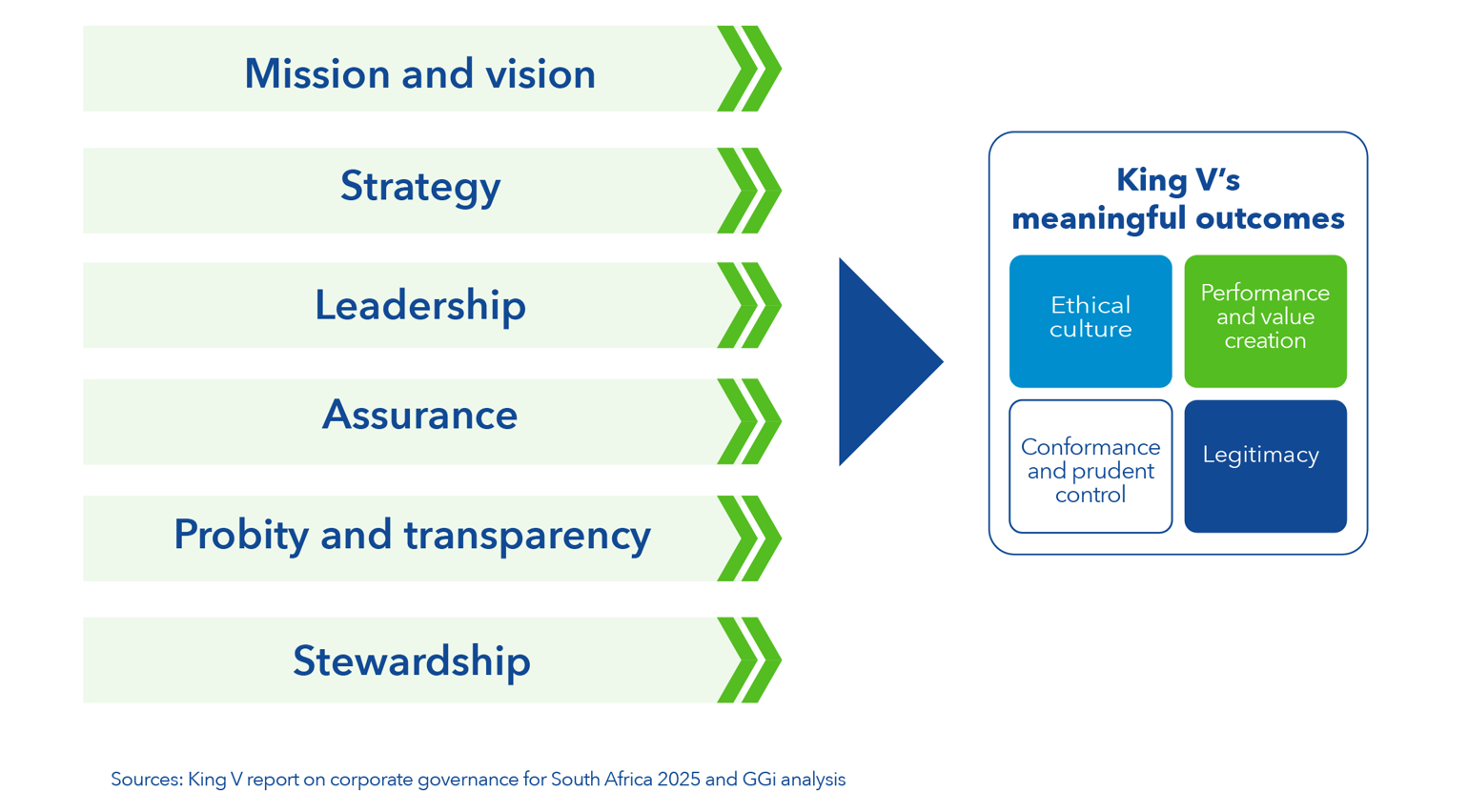
GGi’s governance reviews are grounded in the belief that good governance is contextual, values-driven and ultimately judged by the outcomes it enables. Our approach draws on extensive practical experience and research, and is informed in part by the King V Code, which emphasises governance through meaningful outcomes rather than compliance alone. This lens is particularly helpful for organisations seeking to strengthen board performance and governance maturity. Applied proportionately to your organisation’s context, it allows us to assess how effectively governance supports clarity of purpose, accountability, transparency and informed decision-making. In practice, this means examining how the Board sets direction, how risks are understood and managed, and how assurance arrangements enable confident strategic oversight. It also enables us to consider the quality of board discussion and governance behaviours, not simply the presence of formal governance structures.
3. Good practice and developmental benchmarking
In addition to regulatory and Code-based assessment, we will benchmark Wyke 6th Colleges’ governance approach against wider sector good practice for further education providers and large multi-campus institutions. This will allow the Corporation to understand how its governance arrangements compare with peers while reflecting your specific context. We will use a set of practical, insight-driven tools to support both assessment and reflection, including:
- GGi’s Governing Body Maturity Matrix - This tool assesses governance capability across domains such as strategy, assurance, leadership and stewardship.
- Sector benchmarking - Where helpful, we will compare aspects of your organisation’s governance arrangements with those of similar colleges and further education providers. This may include approaches to board composition, committee structures, board assurance frameworks and stakeholder engagement.
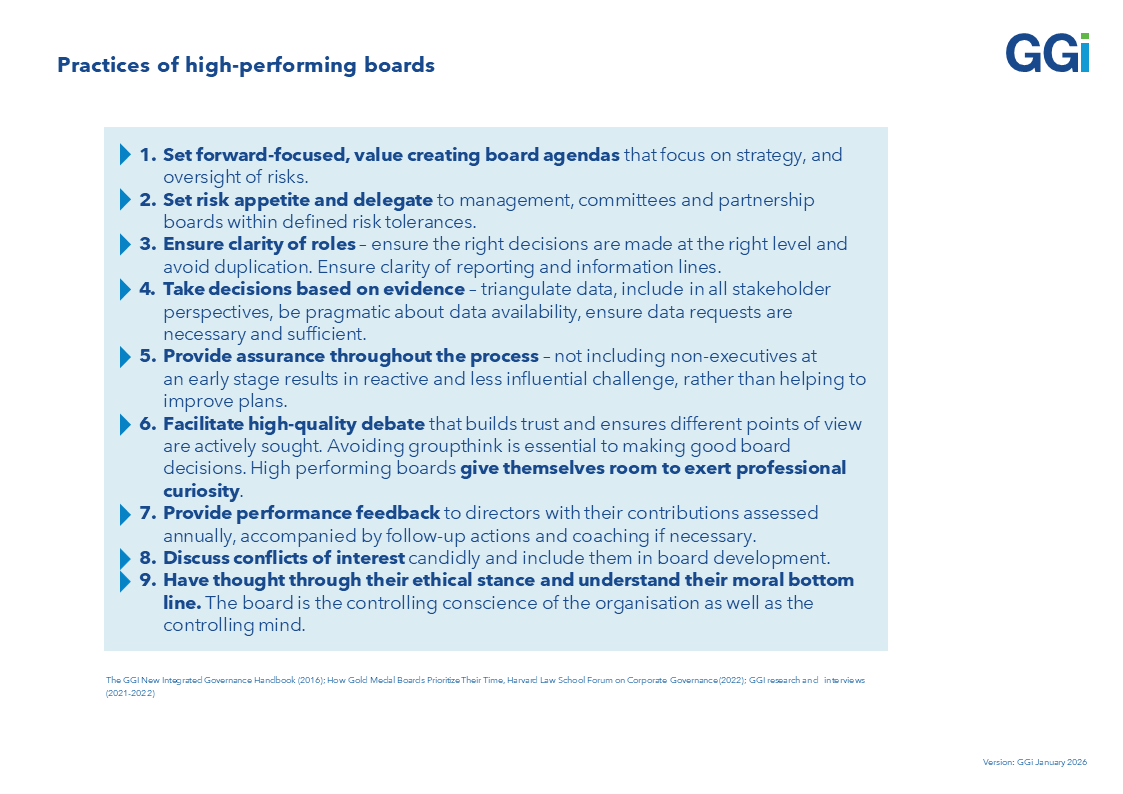
- High-performing board assessment - Drawing on our research and practical work on high-performing boards, we will assess the cultural and behavioural factors that influence board effectiveness. This includes the quality of discussion and challenge, clarity of roles and responsibilities, and how governance supports strategic decision-making across the organisation.
For your organisation, this means:
The review will provide you with a clear, evidence-based assessment of governance effectiveness, identifying both strengths and targeted opportunities for development. It will offer practical, prioritised recommendations focused on enhancing board dynamics, strengthening engagement and improving the quality of strategic discussion and decision-making. The outcome will be a more cohesive, confident and high-performing Board, supported by governance arrangements that enable stronger strategic oversight, clearer assurance and more impactful contribution to organisational leadership and student outcomes.
Methodology
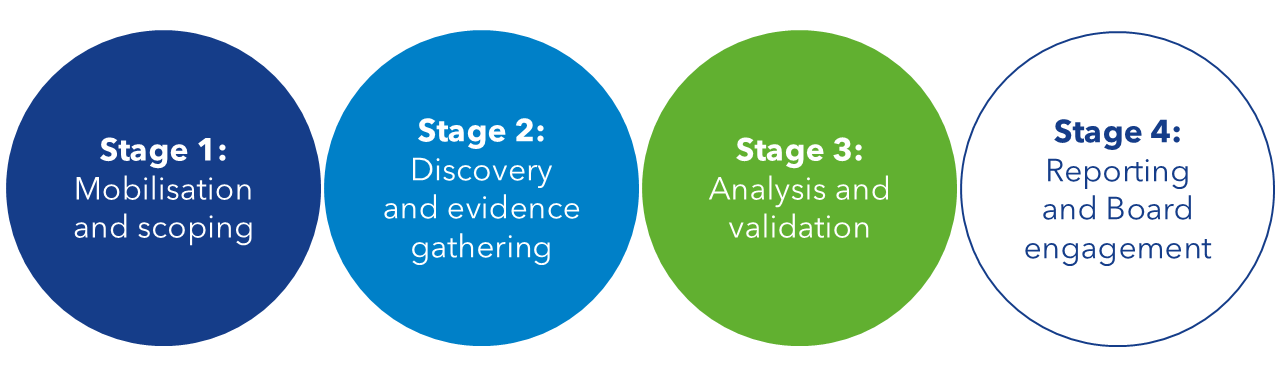
GGi has refined its approach to governance reviews through hundreds of assignments across public purpose organisations. Our methodology is structured but flexible, allowing us to explore governance in depth while ensuring the process remains proportionate and manageable for the organisation. The review is delivered in four clear phases:
- Scoping - We begin with an inception meeting and a small number of scoping interviews to confirm the review’s key lines of enquiry. These conversations help ensure the review reflects Wyke 6th from College’s specific context and focuses on the governance questions most relevant to the Corporation.
- Discovery - In the discovery phase we gather and review evidence from a range of sources. This includes governance documentation, observation of board and committee meetings, and insight gathered through interviews and focus groups. The purpose of this phase is to understand how governance arrangements operate in practice - including the quality of discussion, assurance and decision-making within the Corporation and it’s committees.
- Analysis and testing - All evidence is then brought together through structured triangulation. We analyse documentation, observations and stakeholder perspectives to identify key themes and findings. Emerging conclusions are tested through discussion with senior stakeholders to ensure our interpretation is accurate and grounded in the organisation’s context.
- Reporting and reflection - The final phase focuses on producing a clear and practical report. This sets out strengths, areas for development and recommendations to support continued governance improvement. Findings are normally presented to the Corporation to enable discussion and reflection on the next stage of governance development.
This phased methodology ensures that the review is rigorous and evidence-based while remaining clearly developmental in focus. The intention is not simply to assess governance arrangements, but to provide insight that supports the Corporation in strengthening its effectiveness, enhancing board dynamics and progressing to the next stage of governance maturity. Throughout the process, we will work closely with the Clerk to the Corporation to ensure the review is well-paced and proportionate, minimising the burden on governors while generating a robust and meaningful evidence base that reflects how governance operates in practice.
Quality assurance and project management
Quality assurance
To ensure our methodology delivers this impact, and our outputs are at the quality and standards we hold ourselves to, we embed robust quality assurance practices into every stage of our project delivery to ensure that outputs are accurate, high quality and aligned with client expectations.
Each project is supported by a dedicated Quality Assurance Lead who operates independently from the core delivery team. This individual brings fresh perspective and rigour to the review process and acts as an internal auditor of both the methodology and outputs. Their role includes reviewing all major deliverables. The QA Lead is also available to Homeless Link as an escalation route, should any concerns arise.
In addition, the quality assurance process is supported through regular highlight reports and internal checkpoint reviews. These allow for early identification of any quality concerns and ensure consistency across all communications, findings and outputs.
Project management
To ensure that our projects run within the proposed timelines and budget, GGi adopts a specific project management methodology (based on Prince2) consisting of three phases (initiation, programme delivery and quality assurance). We will agree on a project plan with you at the outset and will meet regularly throughout the process. We will produce highlight reports for these check-in meetings to provide information and assurance on progress (example below) and we will maintain a project risk register.